


Page 43 - Industrial Plants
P. 43
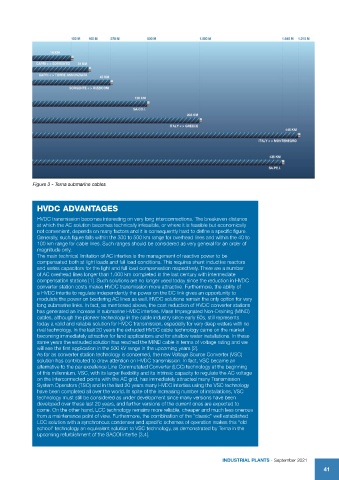
Figure 3 - Terna submarine cables


              HVDC ADVANTAGES
              HVDC transmission becomes interesting on very long interconnections. The breakeven distance
              at which the AC solution becomes technically infeasible, or where it is feasible but economically
              not convenient, depends on many factors and it is consequently hard to define a specific figure.
              Generally, such figure falls within the 300 to 500 km range for overhead lines and within the 40 to
              100 km range for cable lines. Such ranges should be considered as very general for an order of
              magnitude only.
              The main technical limitation of AC interties is the management of reactive power to be
              compensated both at light loads and full load conditions. This requires shunt inductive reactors
              and series capacitors for the light and full load compensation respectively. There are a number
              of AC overhead lines longer than 1.000 km completed in the last century with intermediate
              compensation stations [1]. Such solutions are no longer used today since the reduction in HVDC
              converter station costs makes HVDC transmission more attractive. Furthermore, the ability of
              a HVDC intertie to regulate independently the power on the DC link gives an opportunity to
              modulate the power on bordering AC lines as well. HVDC solutions remain the only option for very
              long submarine links. In fact, as mentioned above, the cost reduction of HVDC converter stations
              has generated an increase in submarine HVDC interties. Mass Impregnated Non-Draining (MIND)
              cables, although the pioneer technology in the cable industry since early 60s, still represents
              today a valid and reliable solution for HVDC transmission, especially for very deep waters with no
              rival technology. In the last 20 years the extruded HVDC cable technology came on the market
              becoming immediately attractive for land applications and for shallow water installations. In these
              same years the extruded solution has reached the MIND cable in terms of voltage rating and we
              will see the first application in the 500 kV range in the upcoming years [2].
              As far as converter station technology is concerned, the new Voltage Source Converter (VSC)
              solution has contributed to draw attention on HVDC transmission. In fact, VSC became an
              alternative to the par excellence Line Commutated Converter (LCC) technology at the beginning
              of this millennium. VSC, with its larger flexibility and its intrinsic capacity to regulate the AC voltage
              on the interconnected points with the AC grid, has immediately attracted many Transmission
              System Operators (TSO) and in the last 20 years many HVDC interties using the VSC technology
              have been completed all over the world. In spite of the increasing number of installations, VSC
              technology must still be considered as under development since many versions have been
              developed over these last 20 years, and further versions of the current ones are expected to
              come. On the other hand, LCC technology remains more reliable, cheaper and much less onerous
              from a maintenance point of view. Furthermore, the combination of the “classic” well established
              LCC solution with a synchronous condenser and specific schemes of operation makes this “old
              school” technology an equivalent solution to VSC technology, as demonstrated by Terna in the
              upcoming refurbishment of the SACOI intertie [3,4].


                                                                               IndustrIal Plants - September 2021
                                                                                                                   41

