


Page 24 - Industrial Plants
P. 24
“The rising penetration of renewable    batteries are currently the cheapest zero-emissions
                              energy will require not just increasing   option for providing balancing services of less than 4
                               amounts of energy storage but also     hours. LDES (with different emerging technologies),
                                developing long-duration storage      can provide duration for days and even weeks, with
                                            solutions                 resilience to an electric grid ready to distribute solar
                                                                      and wind power on a large scale. This extension to
                             complementing direct electrification and helping to   periods lasting days or weeks is the need of
                             address harder to abate sectors: let say that storage   imbalanced RE output or potential outages caused
                             needs remain relatively low up to a share of around   by transmission constraints. LDES technologies are a
                             80% renewables, but increase substantially toward   promising zero-carbon solution for these long-
                             100% renewables, with a growing importance of   duration flexibility needs,  especially those lasting
                             long-term storage for seasonal balancing.  several days.

                             The rising penetration of renewable energy will require   Finally, the need for seasonal flexibility is due to the
                             not just increasing amounts of energy storage but   natural variability of solar irradiation, wind speed,
                             long-duration storage depending on the country and   temperature, and rainfall over weeks and months,
                             the characteristics of its energy market.  and also to extreme weather events.
                             In order to accommodate large amounts of renewable
                             energy new flexibility challenges across different  Some LDES overview and
                             timing are to be considered:             the HYDROGEN solution
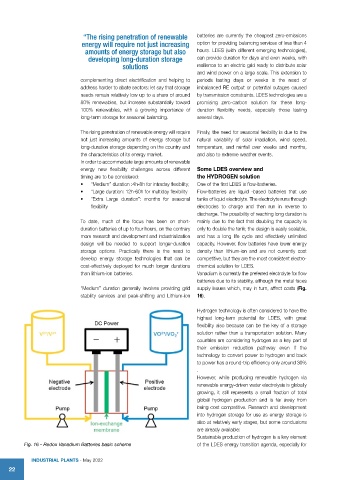
                             •   “Medium” duration :4h-8h for intraday flexibility;  One of the first LDES is flow-batteries.
                             •   “Large duration: 12h-60h for multiday flexibility  Flow-batteries are liquid -based batteries that use
                             •   “Extra Large duration”: months for seasonal   tanks of liquid electrolyte. The electrolyte runs through
                                 flexibility                          electrodes to charge  and then run  in reverse  to
                                                                      discharge. The possibility of reaching long duration is
                             To date, much of the  focus has been on short-  mainly due to the fact that doubling the capacity is
                             duration batteries of up to four hours, on the contrary   only to double the tank; the design is easily scalable,
                             more research and development and industrialization   and has a long life cycle and effectively unlimited
                             design will be needed to support longer-duration   capacity. However, flow batteries have lower energy
                             storage  options.  Practically  there is  the  need  to   density than lithium-ion and are not currently cost
                             develop energy storage technologies that can be   competitive, but they are the most consistent electro-
                             cost-effectively deployed for much longer durations   chemical solution for LDES.
                             than lithium-ion batteries.              Vanadium is currently the preferred electrolyte for flow
                                                                      batteries due to its stability, although the metal faces
                             “Medium” duration generally involves providing grid   supply issues which, may in turn, affect costs (Fig.
                             stability services and peak-shifting and Lithium-ion   16).

                                                                      Hydrogen technology is often considered to have the
                                                                      highest long-term potential for LDES, with great
                                                                      flexibility also because can be the key of a storage
                                                                      solution rather than a transportation solution. Many
                                                                      countries are considering hydrogen as a key part of
                                                                      their  emission  reduction  pathway  even  if  the
                                                                      technology to convert power to hydrogen and back
                                                                      to power has a round-trip efficiency only around 30%
                                                                      .
                                                                      However, while producing renewable hydrogen via
                                                                      renewable energy-driven water electrolysis is globally
                                                                      growing,  it  still  represents  a  small  fraction  of  total
                                                                      global hydrogen production and is far away from
                                                                      being cost competitive. Research and development
                                                                      into hydrogen storage for use as energy storage is
                                                                      also at relatively early stages, but some conclusions
                                                                      are already available:
                                                                      Sustainable production of hydrogen is a key element
          Fig. 16 - Redox Vanadium Batteries basic scheme             of the LDES energy transition agenda, especially for

            INDUSTRIAL PLANTS - May 2022
    22

