


Page 19 - Impiantistica italiana
P. 19
logies that lower costs, reduce energy require-  and no other region on earth desalinates so much
            ments, and ensure environmental responsibility. We   water. The Middle East and North Africa (MENA) ef-
            do this by fostering strategic knowledge sharing on   fectively account for more than 60% of the world’s
            guidelines to improve environmental stewardship   total desalination capacity, where for years, rulers
            in advanced water treatment processes of desali-  from Saudi Arabia, United Arab Emirates, Oman,
            nation and water reuse and bringing stakeholders   Qatar, Bahrain, and Kuwait have ensured clean
            together to share knowledge and promote ongoing   drinking, agricultural, and industrial water for their
            innovation.                               people  through  desalination  and reuse  systems
                                                      that transform seawater or wastewater into a stea-
                 Desalination and reuse will          dy supply of fresh water. Spain, Australia, and Chile
                 expand in the coming years, as       are good examples outside the MENA region, whe-
                                                      re desalination offsets water needs, where Singa-
            “climate change intensifies               pore, Israel, Spain, and the US lead in reuse.
                 drought and contributes to           Other water-stressed countries, such as those in
                                                      North Africa and island nations, have also tapped
                 the diminishing quantity and         the oceans. Even in the American Southwest, offi-
                 quality of freshwater resources;     cials, and urban planners are increasingly looking
                 populations grow, and so             to desalination and reuse as a partial solution for
                                                      cities whose water supplies are under pressure due
                 will the demand for water for        to drought and the effects of climate change.
                 agriculture and industry             Desalination will surely expand in the coming ye-
                                                      ars as climate change intensifies drought and con-
                                                      tributes to the diminishing quantity and quality of
            Desalination and water reuse are essential techno-  freshwater  resources.  At  the  same  time,  popula-
            logy solutions for  supporting  water sustainability   tions grow, and so will the demand for water for
            and  security in  arid, drought-prone  communities,   agriculture and industry. In these circumstances,
            especially on the coast, for drinking water, agricul-  reuse will be essential in improving the quality of
            ture, and industrial water needs. In addition, these   life.
            solutions are instrumental in producing clean, po-  The two primary technologies used worldwide for
            table water and help reduce the demand on our   desalination are thermal and membrane. Ther-
            freshwater sources like groundwater, rivers, lakes,   mal technologies involve heating saline water and
            and aquifers, which are depleting rapidly and some   collecting the condensed vapor to produce fresh
            non replenishable. When part of an integrated wa-  water. Membrane desalination removes salts and
            ter resources management strategy, desalination,   minerals from the water as it passes through a se-
            and  reuse  can  help  preserve  freshwater  sources   mipermeable membrane.
            and support water security.               Several sub-categories within thermal and Seawa-
            Looking across the globe, over the last fifty years,   ter Reverse Osmosis (SWRO) solutions define a
            countries across the Arabian Peninsula and North   detailed process using slightly different techniques
            Africa have heavily depended on desalinated water,   but generally with the same engineering principles.


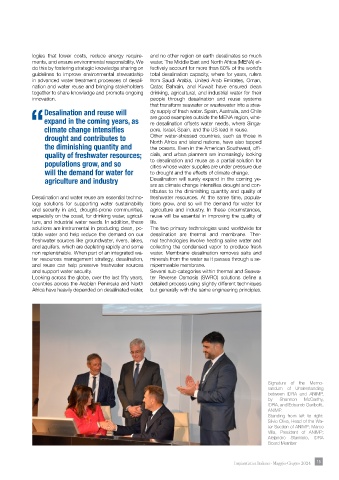
                                                                                               Signature of the Memo-
                                                                                               randum of Understanding
                                                                                               between IDRA and ANIMP,
                                                                                               by  Shannon  McCarthy,
                                                                                               IDRA, and Edoardo Garibotti,
                                                                                               ANIMP.
                                                                                               Standing from left to right:
                                                                                               Silvio Oliva, Head of the Wa-
                                                                                               ter Section of ANIMP; Marco
                                                                                               Villa, President of ANIMP;
                                                                                               Alejandro Sturniolo, IDRA
                                                                                               Board Member


                                                                                   Impiantistica Italiana - Maggio-Giugno 2024  15

