


Page 20 - Impiantistica italiana
P. 20
ASSOCIATION


                                                                      have gone from using 17 kilowatt-hours of energy
                                                                      per cubic meter of freshwater produced to 2.5, and
                                                                      in some cases 2.2, dramatically reducing energy
                                                                      use and carbon footprint. This shift, coupled with
                                                                      energy recovery systems, has dramatically impro-
                                                                      ved performance and lowered costs. Additionally,
                                                                      membrane and plant performance has become
                                                                      more reliable with the introduction of modular sy-
                                                                      stems, automation, and improvements in plant
                                                                      operations.
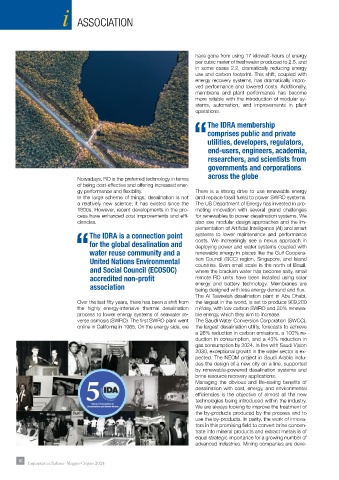
                                                                          The IDRA membership
                                                                          comprises public and private
                                                                     “utilities, developers, regulators,
                                                                          end-users, engineers, academia,
                                                                          researchers, and scientists from
                                                                          governments and corporations
                                                                          across the globe
                            Nowadays, RO is the preferred technology in terms
                            of being cost-effective and offering increased ener-
                            gy performance and fl exibility.          There  is  a  strong  drive  to  use  renewable  energy
                            In the large scheme of things, desalination is not   (and replace fossil fuels) to power SWRO systems.
                            a relatively new science; it has existed since the   The US Department of Energy has invested in pro-
                            1800s. However, recent developments in the pro-  moting innovation with several grand challenges
                            cess have enhanced cost improvements and effi -  for renewables to power desalination systems. We
                            ciencies.                                 also see modular design approaches and the im-
                                                                      plementation of Artifi cial Intelligence (AI) and smart
                                The IDRA is a connection point        systems to lower maintenance and performance
                                for the global desalination and       costs. We increasingly see a nexus approach in
                                                                      deploying power and water systems coupled with
                           “water reuse community and a               renewable energy in places like the Gulf Coopera-
                                 United Nations Environmental         tion Council (GCC) region, Singapore, and Island
                                                                      countries. Even small scale in the north of Brazil,
                                 and Social Council (ECOSOC)          where the brackish water has become salty, small
                                 accredited non-profit                remote RO units have been installed using solar

                                 association                          energy and battery technology. Membranes are
                                                                      being designed with less energy demand and fl ux.
                                                                      The Al Taweelah desalination plant in Abu Dhabi,
                            Over the last fi fty years, there has been a shift from   the largest in the world, is set to produce 909,200
                            the highly energy-intensive thermal desalination   m³/day, with low carbon SWRO and 30% renewa-
                            process to lower energy systems of seawater re-  ble energy, which they aim to increase.
                            verse osmosis (SWRO). The fi rst SWRO plant went   The Saudi Water Conversion Corporation (SWCC),
                            online in California in 1965. On the energy side, we   the largest desalination utility, forecasts to achieve
                                                                      a 26% reduction in carbon emissions, a 100% re-
                                                                      duction in consumption, and a 43% reduction in
                                                                      gas consumption by 2024. In line with Saudi Vision
                                                                      2030, exceptional growth in the water sector is ex-
                                                                      pected. The NEOM project in Saudi Arabia inclu-
                                                                      des the design of a new city on a line, supported
                                                                      by  renewable-powered  desalination  systems  and
                                                                      brine resource recovery applications.
                                                                      Managing the obvious and life-saving benefi ts of
                                                                      desalination with cost, energy, and environmental
                                                                      effi ciencies is the objective of almost all the new
                                                                      technologies being introduced within the industry.
                                                                      We are always looking to improve the treatment of
                                                                      the by-products produced by the process and to
                                                                      use the by-products. In parity, the work of innova-
                                                                      tors in this promising fi eld to convert brine concen-
                                                                      trate into mineral products and extract metals is of
                                                                      equal strategic importance for a growing number of
                                                                      advanced industries. Mining companies are deve-


       16  Impiantistica Italiana - Maggio-Giugno 2024

