


Page 77 - Industrial Plants
P. 77
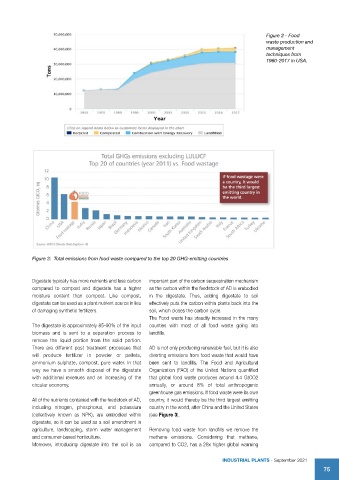
Figure 2 - Food
                                                                                               waste production and
                                                                                               management
                                                                                               techniques from
                                                                                               1960-2017 in USA.


            Figure 3:  Total emissions from food waste compared to the top 20 GHG-emitting countries


            Digestate typically has more nutrients and less carbon   important part of the carbon sequestration mechanism
            compared to compost and digestate has a higher   as the carbon within the feedstock of AD is embodied
            moisture content than compost. Like compost,   in the digestate. Thus, adding digestate to soil
            digestate can be used as a plant nutrient source in lieu   effectively puts the carbon within plants back into the
            of damaging synthetic fertilizers.       soil, which closes the carbon cycle.
                                                     The Food waste has steadily increased in the many
            The digestate is approximately 85-90% of the input   counties with most of all food waste going into
            biomass and is sent to a separation process to   landfills.
            remove  the  liquid  portion  from  the  solid  portion.
            There are different post treatment processes that   AD is not only producing renewable fuel, but it is also
            will produce fertilizer in powder or pellets,   diverting emissions from food waste that would have
            ammonium sulphate, compost, pure water. In that   been sent to landfills. The Food and Agricultural
            way  we have  a smooth disposal of  the  digestate   Organization (FAO) of the United Nations quantified
            with additional revenues and an increasing of the   that global food waste produces around 4.4 GtCO2
            circular economy.                        annually, or around 8% of total anthropogenic
                                                     greenhouse gas emissions. If food waste were its own
            All of the nutrients contained with the feedstock of AD,   country, it would thereby be the third largest emitting
            including nitrogen, phosphorus, and potassium   country in the world, after China and the United States
            (collectively known  as NPK),  are embodied within   (see Figure 3).
            digestate, so it can be used as a soil amendment in
            agriculture, landscaping,  storm water management   Removing food waste from landfills we remove the
            and consumer-based horticulture.         methane emissions. Considering that methane,
            Moreover, introducing digestate into the soil is an   compared to CO2, has a 28x higher global warming

                                                                               IndustrIal Plants - September 2021
                                                                                                                   75

