


Page 65 - 100
P. 65
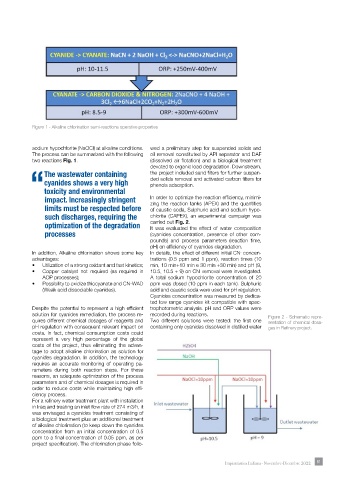
Figure 1 - Alkaline chlorination semi-reactions operative properties


            sodium hypochlorite (NaOCl) at alkaline conditions.   wed a preliminary step for suspended solids and
            The process can be summarized with the following   oil removal constituted by API separator and DAF
            two reactions Fig. 1.                     (dissolved air flotation) and a biological treatment
                                                      devoted to organic load degradation. Downstream,
                 The wastewater containing            the project included sand filters for further suspen-
                 cyanides shows a very high           ded solids removal and activated carbon filters for
                                                      phenols adsorption.
            “toxicity and environmental
                 impact. Increasingly stringent       In order to optimize the reaction efficiency, minimi-
                                                      zing the reaction tanks (APEX) and the quantities
                 limits must be respected before      of caustic soda, Sulphuric acid and sodium hypo-
                 such discharges, requiring the       chlorite (CAPEX), an experimental campaign was
                 optimization of the degradation      carried out Fig. 2.
                                                      It was evaluated the effect of water composition
                 processes                            (cyanides  concentration,  presence  of  other com-
                                                      pounds) and process parameters (reaction time,
                                                      pH) on efficiency of cyanides degradation.
                                                                                     -
            In addition, Alkaline chlorination shows some key   In details, the effect of different initial CN  concen-
            advantages:                               trations (0.5 ppm and 1 ppm), reaction times (10
            •   Utilization of a strong oxidant and fast kinetics;  min, 10 min+10 min e 30 min +30 min) and pH (9,
            •   Copper catalyst not required (as required in   10.5, 10.5 + 9) on CN  removal were investigated.
                                                                       -
                AOP processes);                       A total sodium hypochlorite concentration of 20
            •   Possibility to oxidize thiocyanate and CN-WAD   ppm was dosed (10 ppm in each tank). Sulphuric
                (Weak acid dissociable cyanides).     acid and caustic soda were used for pH regulation.
                                                      Cyanides concentration was measured by dedica-
                                                      ted low range cyanides kit compatible with spec-
            Despite the potential to represent a high efficient   trophotometric analysis. pH and ORP values were
            solution for cyanides remediation, the process re-  recorded during reactions.     Figure 2 - Schematic repre-
            quires different chemical dosages of reagents and   Two different solutions were tested: the first one   sentation of chemical dosa-
            pH regulation with consequent relevant impact on   containing only cyanides dissolved in distilled water   ges in Refinery project.
            costs. In fact, chemical consumption costs could
            represent  a  very  high  percentage  of  the global
            costs of the project, thus eliminating the advan-
            tage to adopt alkaline chlorination as solution for
            cyanides degradation. In addition, the technology
            requires an accurate monitoring of operating pa-
            rameters during both reaction steps. For these
            reasons, an adequate optimization of the process
            parameters and of chemical dosages is required in
            order to reduce costs while maintaining high effi-
            ciency process.
            For a refinery water treatment plant with installation
            in Iraq and treating an inlet flow rate of 274 m3/h, it
            was envisaged a cyanides treatment consisting of
            a biological treatment plus an additional treatment
            of alkaline chlorination (to keep down the cyanides
            concentration from an initial concentration of 0.5
            ppm to a final concentration of 0.05 ppm, as per
            project specification). The chlorination phase follo-


                                                                                Impiantistica Italiana - Novembre-Dicembre 2022  61

