


Page 67 - 100
P. 67
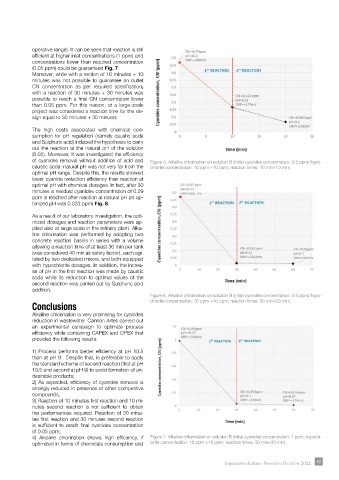
operative range). It can be seen that reaction is still
            effi cient at higher inlet concentrations (1 ppm) and
            concentrations  lower  than  required  concentration
            (0.05 ppm) could be guaranteed Fig. 7.
            Moreover, while with a rection of 10 minutes + 10
            minutes was not possible to guarantee an outlet
            CN concentration as per required specifi cation,
            with a reaction of 30 minutes + 30 minutes was
            possible to reach a fi nal CN concentration lower
            than 0.05 ppm.  For this reason, at a large-scale
            project was considered a reaction time for the de-
            sign equal to 30 minutes + 30 minutes.

            The high costs associated with chemical con-
            sumption  for  pH  regulation  (namely  caustic  soda
            and Sulphuric acid) induced the hypothesis to carry
            out the reaction at the natural pH of the solution
            (8.05). Moreover, it was investigated the effi ciency
            of cyanides removal without addition of acid and   Figure 5. Alkaline chlorination on solution B (initial cyanides concentration: 0.5 ppm; hypo-
            caustic soda: natural pH was not very far from the   chlorite concentration: 10 ppm +10 ppm; reaction times: 10 min+10 min).
            optimal pH range. Despite this, the results showed
            lower cyanide reduction effi ciency than reaction at
            optimal pH with chemical dosages. In fact, after 30
            minutes a residual cyanides concentration of 0.29
            ppm is reached after reaction at natural pH (at op-
            timized pH was 0.033 ppm) Fig. 8.

            As a result of our laboratory investigation, the opti-
            mized dosages and reaction parameters were ap-
            plied also at large scale in the refi nery plant. Alka-
            line chlorination was performed by adopting two
            concrete reaction basins in series with a volume
            allowing a reaction time of at least 30 min per tank
            (was considered 40 min as safety factor), each agi-
            tated by two dedicated mixers, and both equipped
            with hypochlorite dosages. In addition, the increa-
            se of pH in the fi rst reaction was made by caustic
            soda while its reduction to optimal values of the
            second reaction was carried out by Sulphuric acid
            addition.
                                                      Figure 6. Alkaline chlorination on solution B (initial cyanides concentration: 0.5 ppm; hypo-
            Conclusions                               chlorite concentration: 10 ppm +10 ppm; reaction times: 30 min+30 min).
            Alkaline chlorination is very promising for cyanides
            reduction in wastewater. Cannon Artes carried out
            an experimental campaign to optimize process
            effi ciency while containing CAPEX and OPEX that
            provided the following results:
            1) Process performs better effi ciency at pH 10.5
            than at pH 9.  Despite that, is preferable to apply
            the standard scheme of second reaction (fi rst at pH
            10.5 and second at pH 9) to avoid formation of un-
            desirable products;
            2) As expected, effi ciency of cyanides removal is
            strongly reduced in presence of other competitive
            compounds;
            3) Reaction of 10 minutes fi rst reaction and 10 mi-
            nutes second reaction is not suffi cient to obtain
            the performances required. Reaction of 30 minu-
            tes fi rst reaction and 30 minutes second reaction
            is  suffi cient  to  reach  fi nal  cyanides  concentration
            of 0.05 ppm;
            4)  Alkaline  chlorination  shows  high  effi ciency,  if   Figure 7. Alkaline chlorination on solution B (initial cyanides concentration: 1 ppm; hypoch-
            optimized in terms of chemicals consumption and   lorite concentration: 10 ppm +10 ppm; reaction times: 30 min+30 min).


                                                                                Impiantistica Italiana - Novembre-Dicembre 2022  63

