


Page 66 - 100
P. 66
NEW TECHNOLOGIES


                                                               Solution A                 Solution B
                                     Compound                Concentration              Concentration
                                  Potassium cyanide             0.5 ppm                    0.5 ppm
                                        COD                        -                       830 ppm
       Table 1 - Composition of so-  Total Phosphorus              -                       25 ppm
       lution A and solution B used   Ammonia                      -                       48 ppm
       for experimental campaign
                                      Chlorides                    -                       193 ppm
                                       Sulfates                    -                       140 ppm


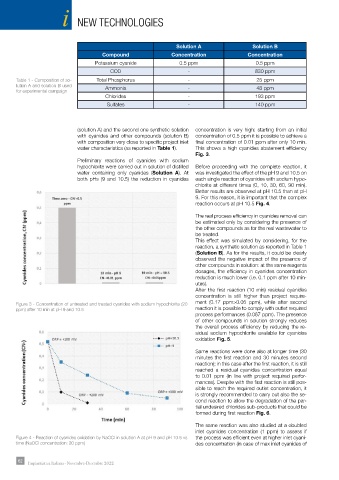
                            (solution A) and the second one synthetic solution   concentration is very high: starting from an initial
                            with cyanides and other compounds (solution  B)   concentration of 0.5 ppm it is possible to achieve a
                            with composition very close to specific project inlet   final concentration of 0.01 ppm after only 10 min.
                            water characteristics (as reported in Table 1).  This shows a high cyanides abatement efficiency
                                                                      Fig. 3.
                            Preliminary reactions of cyanides with sodium
                            hypochlorite were carried out in solution of distilled   Before proceeding with the complete reaction, it
                            water  containing  only  cyanides  (Solution  A).  At   was investigated the effect of the pH 9 and 10.5 on
                            both pHs  (9 and 10.5) the  reduction in  cyanides   each single reaction of cyanides with sodium hypo-
                                                                      chlorite at different times (0, 10, 30, 60, 90 min).
                                                                      Better results are observed at pH 10.5 than at pH
                                                                      9. For this reason, it is important that the complex
                                                                      reaction occurs at pH 10.5 Fig. 4.

                                                                      The real process efficiency in cyanides removal can
                                                                      be estimated only by considering the presence of
                                                                      the other compounds as for the real wastewater to
                                                                      be treated.
                                                                      This effect was simulated by considering, for the
                                                                      reaction, a synthetic solution as reported in Table 1
                                                                      (Solution B). As for the results, it could be clearly
                                                                      observed the negative impact of the presence of
                                                                      other compounds in solution: at the same reagents
                                                                      dosages, the efficiency in cyanides concentration
                                                                      reduction is much lower (i.e. 0.1 ppm after 10 min-
                                                                      utes).
                                                                      After the first reaction (10 min) residual cyanides
                                                                      concentration is still higher than project require-
       Figure 3 - Concentration of untreated and treated cyanides with sodium hypochlorite (20   ment (0.17 ppm>0.05 ppm), while after second
       ppm) after 10 min at pH 9 and 10.5                             reaction it is possible to comply with outlet required
                                                                      process performances (0.067 ppm). The presence
                                                                      of  other  compounds  in  solution  strongly  reduces
                                                                      the overall process efficiency by reducing the re-
                                                                      sidual sodium hypochlorite available for cyanides
                                                                      oxidation Fig. 5.
                                                                      Same reactions were done also at longer time (30
                                                                      minutes the first reaction and 30 minutes second
                                                                      reaction); in this case after the first reaction, it is still
                                                                      reached a residual cyanides concentration equal
                                                                      to  0.01  ppm  (in  line  with  project  required  perfor-
                                                                      mances). Despite with the first reaction is still pos-
                                                                      sible to reach the required outlet concentration, it
                                                                      is strongly recommended to carry out also the se-
                                                                      cond reaction to allow the degradation of the par-
                                                                      tial undesired chlorides sub-products that could be
                                                                      formed during first reaction Fig. 6.
                                                                      The same reaction was also studied at a doubled
                                                                      inlet cyanides concentration (1 ppm) to assess if
       Figure 4 - Reaction of cyanides oxidation by NaOCl in solution A at pH 9 and pH 10.5 vs   the process was efficient even at higher inlet cyani-
       time (NaOCl concentration: 20 ppm)                             des concentration (in case of max inlet cyanides of


       62  Impiantistica Italiana - Novembre-Dicembre 2022

