


Page 31 - 76
P. 31
USD (2018) billion    4,5                            Non-traditional energy companies
                   4,0
                                                                      Other
                   3,5
                   3,0
                   2,5                                                ICT and electronics
                                                                      Transport
                   2,0
                   1,5                                                Batteries
                   1,0
                                                                    Traditional energy companies
                   0,5
                  0,0                                                 Energy equipment & service suppliers
                     Average  2012   2013   2014   2015   2016   2017   2018   2019
                     2007-11                                 YTD      Utilities and IPPs

                                                                      Oil & gas
            Note: ICT = information and communication technology. Deals types include grant, seed, series A, series B, growth equity,
            private investment in public equity (PIPE), coin/token offering and late-stage private equity. Unless otherwise stated, deal
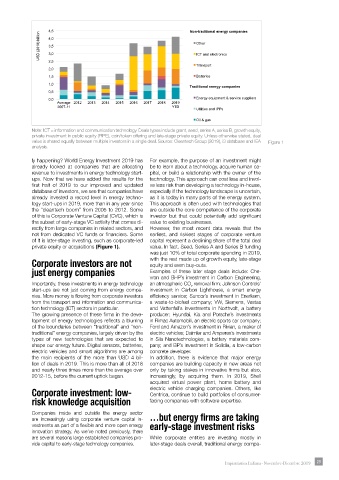
            value is shared equally between multiple investors in a single deal. Source: Cleantech Group (2019), i3 database and IEA   Figure 1
            analysis.
            ly happening? World Energy Investment 2019 has   For example, the purpose of an investment might
            already looked at companies that are allocating   be to learn about a technology, acquire human ca-
            revenue to investments in energy technology start-  pital, or build a relationship with the owner of the
            ups. Now that we have added the results for the   technology. This approach can cost less and invol-
            first half of 2019 to our improved and updated   ve less risk than developing a technology in-house,
            database of investors, we see that companies have   especially if the technology landscape is uncertain,
            already invested a record level in energy techno-  as it is today in many parts of the energy system.
            logy start-ups in 2019, more than in any year since   This approach is often used with technologies that
            the “cleantech boom” from 2005 to 2012. Some   are outside the core competence of the corporate
            of this is Corporate Venture Capital (CVC), which is   investor but that could potentially add signifi cant
            the subset of early-stage VC activity that comes di-  value to existing businesses.
            rectly from large companies in related sectors, and   However, the most recent data reveals that the
            not from dedicated VC funds or fi nanciers. Some   earliest, and riskiest stages of corporate venture
            of it is later-stage investing, such as corporate-led   capital represent a declining share of the total deal
            private equity or acquisitions (Figure 1).  value. In fact, Seed, Series A and Series B funding
                                                      was just 10% of total corporate spending in 2019,
            Corporate investors are not               with the rest made up of growth equity, late-stage
                                                      equity and even buy-outs.
            just energy companies                     Examples of  these  later  stage  deals include: Che-
                                                      vron and BHP’s investment in Carbon Engineering,
            Importantly, these investments in energy technology   an atmospheric CO  removal firm; Johnson Controls’
                                                                    2
            start-ups are not just coming from energy compa-  investment in  Carbon Lighthouse, a smart energy
            nies. More money is fl owing from corporate investors   effi ciency service; Suncor’s investment in Enerkem,
            from the transport and information and communica-  a waste-to-biofuel company; VW, Siemens, Vestas
            tion technology (ICT) sectors in particular.  and  Vattenfall’s  investments  in  Northvolt,  a  battery
            The growing presence of these fi rms in the deve-  producer; Hyundai, Kia and Porsche’s investments
            lopment of energy technologies refl ects a blurring   in Rimac Automobili, an electric sports car company;
            of the boundaries between “traditional” and “non-  Ford and Amazon’s investment in Rivian, a maker of
            traditional” energy companies, largely driven by the   electric vehicles; Daimler and Amperex’s investments
            types  of  new  technologies  that  are  expected  to   in  Sila Nanotechnologies, a battery materials com-
            shape our energy future. Digital sensors, batteries,   pany; and BP’s investment in Solidia, a low-carbon
            electric vehicles and smart algorithms are among   concrete developer.
            the main recipients of the more than USD 4  bil-  In addition, there is evidence that major energy
            lion of deals in 2019. This is more than all of 2018   companies are building capacity in new areas not
            and nearly three times more than the average over   only by taking stakes in innovative fi rms but also,
            2012-15, before the current uptick began.  increasingly,  by  acquiring  them.  In  2019,  Shell
                                                      acquired  virtual  power  plant,  home  battery  and
            Corporate investment: low-                electric vehicle charging companies. Others, like
                                                      Centrica, continue to build portfolios of consumer-
            risk knowledge acquisition                facing companies with software expertise.

            Companies inside and outside the energy sector
            are increasingly using corporate venture capital in- …but energy fi rms are taking
            vestments as part of a fl exible and more open energy   early-stage investment risks
            innovation strategy. As we’ve noted previously, there
            are several reasons large established companies pro-  While corporate entities are investing mostly in
            vide capital to early-stage technology companies.  later-stage deals overall, traditional energy compa-


                                                                                Impiantistica Italiana - Novembre-Dicembre 2019  29

