


Page 41 - 77
P. 41
Q4 2019
ESG Investing
Exhibit 3 of 4
and growth opportunities as the impetus for star- Exhibit 3
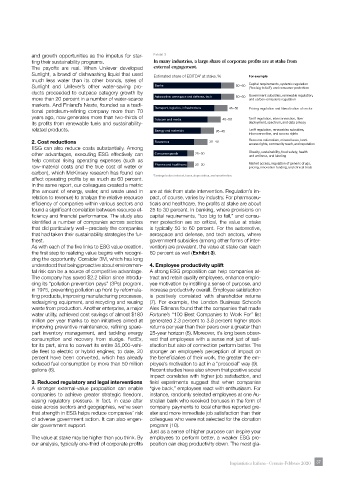
ting their sustainability programs. In many industries, a large share of corporate pro
ts are at stake from
The payoffs are real. When Unilever developed external engagement.
Sunlight, a brand of dishwashing liquid that used Estimated share of EBITDA at stake, % For example
1
much less water than its other brands, sales of
Sunlight and Unilever’s other water-saving pro- Banks 50–60 Capital requirements, systemic regulation
(“too big to fail”), and consumer protection
ducts proceeded to outpace category growth by Government subsidies, renewable regulation,
more than 20 percent in a number of water-scarce Automotive, aerospace and defense, tech 50–60 and carbon-emissions regulation
markets. And Finland’s Neste, founded as a tradi-
tional petroleum-refining company more than 70 Transport, logistics, infrastructure 45–55 Pricing regulation and liberalization of sector
years ago, now generates more than two-thirds of Telecom and media 40–50 Tari regulation, interconnection,
ber
its profits from renewable fuels and sustainability- deployment, spectrum, and data privacy
related products. Energy and materials 35–45 Tari regulation, renewables subsidies,
interconnection, and access rights
2. Cost reductions Resources 30–40 Resource nationalism, mineral taxes, land-
access rights, community reach, and reputation
ESG can also reduce costs substantially. Among
other advantages, executing ESG effectively can Consumer goods 25–30 Obesity, sustainability, food safety, health
and wellness, and labeling
help combat rising operating expenses (such as Market access, regulation of generic drugs,
raw-material costs and the true cost of water or Pharma and healthcare 25–30 pricing, innovation funding, and clinical trials
carbon), which McKinsey research has found can 1 Earnings before interest, taxes, depreciation, and amortization.
affect operating profits by as much as 60 percent.
In the same report, our colleagues created a metric
(the amount of energy, water, and waste used in are at risk from state intervention. Regulation’s im-
relation to revenue) to analyze the relative resource pact, of course, varies by industry. For pharmaceu-
efficiency of companies within various sectors and ticals and healthcare, the profits at stake are about
varies by industry. For pharmaceuticals and healthcare, the profits at stake are about
found a significant correlation between resource ef- 25 to 30 percent. In banking, where provisions on
25 to 30 percent. In banking, where provisions on capital requirements, “too big
to fail,” and consumer protection are so critical, the value at stake is typically 50 to
ficiency and financial performance. The study also capital requirements, “too big to fail,” and consu-
60 percent. For the automotive, aerospace and defense, and tech sectors, where
identified a number of companies across sectors mer protection are so critical, the value at stake
government subsidies (among other forms of intervention) are prevalent, the value at
that did particularly well—precisely the companies is typically 50 to 60 percent. For the automotive,
stake can reach 60 percent as well (Exhibit 3).
that had taken their sustainability strategies the fur- aerospace and defense, and tech sectors, where
thest. government subsidies (among other forms of inter-
4. Employee productivity uplift
As with each of the five links to ESG value creation, vention) are prevalent, the value at stake can reach
A strong ESG proposition can help companies attract and retain quality employees,
the first step to realizing value begins with recogni- 60 percent as well (Exhibit 3).
enhance employee motivation by instilling a sense of purpose, and increase productivity
zing the opportunity. Consider 3M, which has long overall. Employee satisfaction is positively correlated with shareholder returns. For
7
understood that being proactive about environmen- 4. Employee productivity uplift
example, the London Business School’s Alex Edmans found that the companies that
made Fortune’s “100 Best Companies to Work For” list generated 2.3 percent to
tal risk can be a source of competitive advantage. A strong ESG proposition can help companies at-
3.8 percent higher stock returns per year than their peers over a greater than 25-year
The company has saved $2.2 billion since introdu- tract and retain quality employees, enhance emplo-
8
horizon. Moreover, it’s long been observed that employees with a sense not just
cing its “pollution prevention pays” (3Ps) program, yee motivation by instilling a sense of purpose, and
in 1975, preventing pollution up front by reformula- increase productivity overall. Employee satisfaction
ting products, improving manufacturing processes, is positively correlated with shareholder returns
7
Alex Edmans, “Does the stock market fully value intangibles? Employee satisfaction and equity prices,” Journal of Financial
redesigning equipment, and recycling and reusing (7). For example, the London Business School’s
Economics, September 2011, Volume 101, Number 3, pp. 621–40, sciencedirect.com.
waste from production. Another enterprise, a major Alex Edmans found that the companies that made
8
Alex Edmans, “The link between job satisfaction and firm value, with implications for corporate social responsibility,”
Academy of Management Perspectives, November 2012, Volume 26, Number 4, pp. 1–9, journals.aom.org.
water utility, achieved cost savings of almost $180 Fortune’s “100 Best Companies to Work For” list
million per year thanks to lean initiatives aimed at generated 2.3 percent to 3.8 percent higher stock
improving preventive maintenance, refining spare- returns per year than their peers over a greater than
part inventory management, and tackling energy 25-year horizon (8). Moreover, it’s long been obser-
consumption and recovery from sludge. FedEx, 6 ved that employees with a sense not just of sati-
for its part, aims to convert its entire 35,000-vehi- sfaction but also of connection perform better. The
cle fleet to electric or hybrid engines; to date, 20 stronger an employee’s perception of impact on
percent have been converted, which has already the beneficiaries of their work, the greater the em-
reduced fuel consumption by more than 50 million ployee’s motivation to act in a “prosocial” way (9).
gallons (6). Recent studies have also shown that positive social
impact correlates with higher job satisfaction, and
3. Reduced regulatory and legal interventions field experiments suggest that when companies
A stronger external-value proposition can enable “give back,” employees react with enthusiasm. For
companies to achieve greater strategic freedom, instance, randomly selected employees at one Au-
easing regulatory pressure. In fact, in case after stralian bank who received bonuses in the form of
case across sectors and geographies, we’ve seen company payments to local charities reported gre-
that strength in ESG helps reduce companies’ risk ater and more immediate job satisfaction than their
of adverse government action. It can also engen- colleagues who were not selected for the donation
der government support. program (10).
Just as a sense of higher purpose can inspire your
The value at stake may be higher than you think. By employees to perform better, a weaker ESG pro-
our analysis, typically one-third of corporate profits position can drag productivity down. The most gla-
Impiantistica Italiana - Gennaio-Febbraio 2020 37 37

