


Page 40 - 77
P. 40
Q4 2019
ESG Investing
Exhibit 1 of 4
sustainability
Exhibit 1
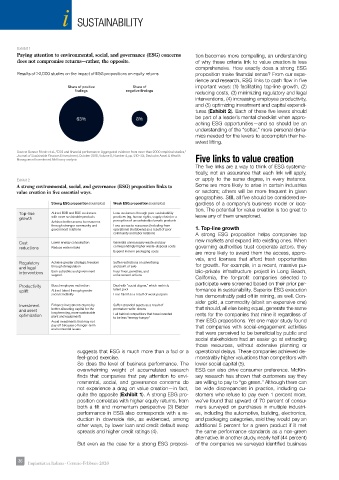
Paying attention to environmental, social, and governance (ESG) concerns tion becomes more compelling, an understanding
does not compromise returns—rather, the opposite. of why these criteria link to value creation is less
comprehensive. How exactly does a strong ESG
Results of >2,000 studies on the impact of ESG propositions on equity returns proposition make financial sense? From our expe-
rience and research, ESG links to cash flow in five
Share of positive Share of important ways: (1) facilitating top-line growth, (2)
ndings negative ndings
reducing costs, (3) minimizing regulatory and legal
interventions, (4) increasing employee productivity,
and (5) optimizing investment and capital expendi-
tures (Exhibit 2). Each of these five levers should
63% 8% be part of a leader’s mental checklist when appro-
aching ESG opportunities—and so should be an
understanding of the “softer,” more personal dyna-
Q4 2019 mics needed for the levers to accomplish their he-
ESG Investing aviest lifting.
Exhibit 2 of 4
Source: Gunnar Friede et al., “ESG and nancial performance: Aggregated evidence from more than 2000 empirical studies,”
Journal of Sustainable Finance & Investment, October 2015, Volume 5, Number 4, pp. 210–33; Deutsche Asset & Wealth Five links to value creation
Management Investment; McKinsey analysis
The five links are a way to think of ESG systema-
But even as the case for a strong ESG proposition becomes more compelling, an tically, not an assurance that each link will apply,
Exhibit 2 understanding of why these criteria link to value creation is less comprehensive. How or apply to the same degree, in every instance.
exactly does a strong ESG proposition make financial sense? From our experience
A strong environmental, social, and governance (ESG) proposition links to Some are more likely to arise in certain industries
value creation in ve essential ways. or sectors; others will be more frequent in given
and research, ESG links to cash flow in five important ways: (1) facilitating top-line
growth, (2) reducing costs, (3) minimizing regulatory and legal interventions, (4) increasing geographies. Still, all five should be considered re-
Weak ESG proposition (examples)
Strong ESG proposition (examples)
employee productivity, and (5) optimizing investment and capital expenditures gardless of a company’s business model or loca-
(Exhibit 2). Each of these five levers should be part of a leader’s mental checklist
Top-line Attract B2B and B2C customers Lose customers through poor sustainability tion. The potential for value creation is too great to
leave any of them unexplored.
practices (eg, human rights, supply chain) or a
with more sustainable products
growth when approaching ESG opportunities—and so should be an understanding of
perception of unsustainable/unsafe products
Achieve better access to resources
the “softer,” more personal dynamics needed for the levers to accomplish their
through stronger community and
Lose access to resources (including from
government relations
heaviest lifting. operational shutdowns) as a result of poor 1. Top-line growth
community and labor relations A strong ESG proposition helps companies tap
Cost Five links to value creation Generate unnecessary waste and pay new markets and expand into existing ones. When
Lower energy consumption
reductions Reduce water intake correspondingly higher waste-disposal costs governing authorities trust corporate actors, they
The five links are a way to think of ESG systematically, not an assurance that each
Expend more in packaging costs
link will apply, or apply to the same degree, in every instance. Some are more are more likely to award them the access, appro-
vals, and licenses that afford fresh opportunities
likely to arise in certain industries or sectors; others will be more frequent in given
Regulatory Achieve greater strategic freedom Suer restrictions on advertising for growth. For example, in a recent, massive pu-
geographies. Still, all five should be considered regardless of a company’s business
and legal through deregulation and point of sale
interventions Earn subsidies and government Incur
nes, penalties, and blic–private infrastructure project in Long Beach,
model or location. The potential for value creation is too great to leave any of
support
enforcement actions
them unexplored. California, the for-profit companies selected to
Productivity Boost employee motivation Deal with “social stigma,” which restricts participate were screened based on their prior per-
uplift 1. Top-line growth talent pool formance in sustainability. Superior ESG execution
Attract talent through greater
Lose talent as a result of weak purpose
social credibility
A strong ESG proposition helps companies tap new markets and expand into existing has demonstrably paid off in mining, as well. Con-
ones. When governing authorities trust corporate actors, they are more likely to award
Investment Enhance investment returns by Suer stranded assets as a result of sider gold, a commodity (albeit an expensive one)
and asset better allocating capital for the premature write-downs that should, all else being equal, generate the same
them the access, approvals, and licenses that afford fresh opportunities for growth.
long term (eg, more sustainable
optimization plant and equipment) Fall behind competitors that have invested rents for the companies that mine it regardless of
For example, in a recent, massive public–private infrastructure project in Long Beach,
to be less “energy hungry”
Avoid investments that may not
California, the for-profit companies selected to participate were screened based their ESG propositions. Yet one major study found
pay o because of longer-term
that companies with social-engagement activities
on their prior performance in sustainability. Superior ESG execution has demonstrably
environmental issues
paid off in mining, as well. Consider gold, a commodity (albeit an expensive one) that were perceived to be beneficial by public and
that should, all else being equal, generate the same rents for the companies that mine social stakeholders had an easier go at extracting
those resources, without extensive planning or
suggests that ESG is much more than a fad or a
it regardless of their ESG propositions. Yet one major study found that companies operational delays. These companies achieved de-
feel-good exercise.
with social-engagement activities that were perceived to be beneficial by public and monstrably higher valuations than competitors with
3
So does the level of business performance. The
social stakeholders had an easier go at extracting those resources, without extensive lower social capital (5).
overwhelming weight of accumulated research
planning or operational delays. These companies achieved demonstrably higher ESG can also drive consumer preference. McKin-
finds that companies that pay attention to envi-
valuations than competitors with lower social capital. 5 sey research has shown that customers say they
ronmental, social, and governance concerns do are willing to pay to “go green.” Although there can
not experience a drag on value creation—in fact,
ESG can also drive consumer preference. McKinsey research has shown that customers be wide discrepancies in practice, including cu-
say they are willing to pay to “go green.” Although there can be wide discrepancies stomers who refuse to pay even 1 percent more,
quite the opposite (Exhibit 1). A strong ESG pro-
in practice, including customers who refuse to pay even 1 percent more, we’ve found we’ve found that upward of 70 percent of consu-
position correlates with higher equity returns, from
that upward of 70 percent of consumers surveyed on purchases in multiple industries, mers surveyed on purchases in multiple industri-
both a tilt and momentum perspective (3) Better
including the automotive, building, electronics, and packaging categories, said they es, including the automotive, building, electronics,
performance in ESG also corresponds with a re-
would pay an additional 5 percent for a green product if it met the same performance and packaging categories, said they would pay an
duction in downside risk, as evidenced, among
standards as a nongreen alternative. In another study, nearly half (44 percent) of
other ways, by lower loan and credit default swap additional 5 percent for a green product if it met
spreads and higher credit ratings (4). the same performance standards as a non-green
5 Sinziana Dorobantu, Witold J. Henisz, and Lite J. Nartey, “Spinning gold: The financial returns to stakeholder engagement,” alternative. In another study, nearly half (44 percent)
Strategic Management Journal, December 2014, Volume 35, Number 12, pp. 1727–48, onlinelibrary.wiley.com. of the companies we surveyed identified business
But even as the case for a strong ESG proposi-
36 36 Impiantistica Italiana - Gennaio-Febbraio 2020
4

