


Page 55 - 77
P. 55
What’s next for the IEA?                  common international standards. As the global
                                                      energy organisation that covers all fuels and all
            The International Energy Agency will help go-  technologies, the IEA will continue to provide ri-
            vernments around the world to establish what role   gorous  analysis  and  policy advice  to  support  in-
            hydrogen can play in their long-term energy strate-  ternational co-operation and to conduct effective
            gies. The world should seize today’s unpreceden-  tracking of progress in the years ahead.
            ted opportunity to take advantage of hydrogen’s
            vast potential and make it a key part of our sustai-  While this publication is a milestone for IEA work
            nable energy future.                      amidst  resurgent  interest  and  sometimes  conflic-
            International co-operation is vital to accelerate the   ting information on hydrogen, it is just one element
            growth of versatile, clean hydrogen around the   in IEA’s hydrogen portfolio. The IEA hydrogen web
            world. If governments work to scale up hydrogen in   pages also include downloadable databases on
            a co-ordinated way, it can help to spur investments   hydrogen policies and projects, as well as interacti-
            in factories and infrastructure that will bring down   ve charts. They will soon provide a knowledge hub
            costs  and  enable  the sharing  of knowledge  and   for the recently launched Clean Energy Ministerial
            best practices. Trade in hydrogen will benefit from   Initiative on Hydrogen.


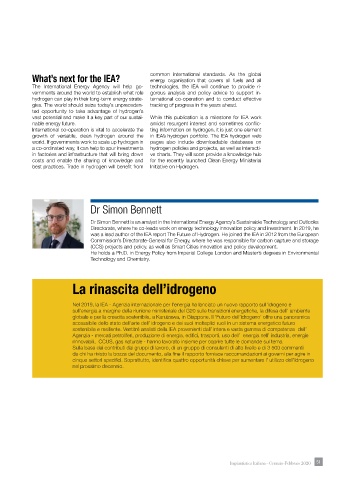
                                 Dr Simon Bennett


                                 Dr Simon Bennett is an analyst in the International Energy Agency’s Sustainable Technology and Outlooks
                                 Directorate, where he co-leads work on energy technology innovation policy and investment. In 2019, he
                                 was a lead author of the IEA report The Future of Hydrogen. He joined the IEA in 2012 from the European
                                 Commission’s Directorate-General for Energy, where he was responsible for carbon capture and storage
                                 (CCS) projects and policy, as well as Smart Cities innovation and policy development.
                                 He holds a Ph.D. in Energy Policy from Imperial College London and Master’s degrees in Environmental
                                 Technology and Chemistry.


                           La rinascita dell’idrogeno


                           Nel 2019, la IEA - Agenzia internazionale per l’energia ha lanciato un nuovo rapporto sull’idrogeno e
                           sull’energia a margine della riunione ministeriale del G20 sulle transizioni energetiche, la difesa dell’ ambiente
                           globale e per la crescita sostenibile, a Karuizawa, in Giappone. Il ‘Futuro dell’idrogeno’ offre una panoramica
                           accessibile dello stato dell’arte dell’ idrogeno e dei suoi molteplici ruoli in un sistema energetico futuro
                           sostenibile e resiliente. Ventitré analisti della IEA provenienti dall’ intera e vasta gamma di competenze  dell’
                           Agenzia - mercati petroliferi, produzione di energia, edifici, trasporti, uso dell’  energia nell’ industria, energie
                           rinnovabili,  CCUS, gas naturale - hanno lavorato insieme per coprire tutte le domande sul tema.
                           Sulla base dei contributi dai gruppi di lavoro, di un gruppo di consulenti di alto livello e di 3 500 commenti
                           da chi ha rivisto la bozza del documento, alla fine il rapporto fornisce raccomandazioni ai governi per agire in
                           cinque settori specifici. Soprattutto, identifica quattro opportunità chiave per aumentare l’ utilizzo dell’idrogeno
                           nel prossimo decennio.


                                                                                  Impiantistica Italiana - Gennaio-Febbraio 2020  51 51

