


Page 62 - Industrial Plants
P. 62
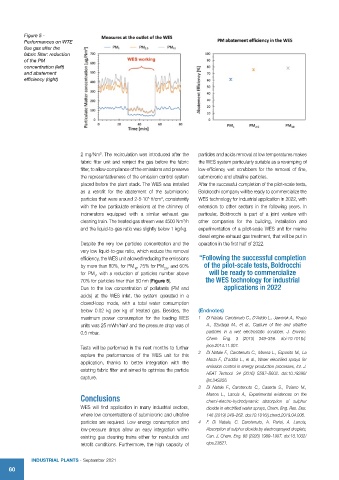
Fig ure 5 -
          Performances on WTE
          flue gas after the
          fabric filter: reduction
          of the PM
          concentration (left)
          and abatement
          efficiency (right)


                             2 mg/Nm . The recirculation was introduced after the   particles and acids removal at low temperatures makes
                                    3
                             fabric filter unit and reinject the gas before the fabric   the WES system particularly suitable as a revamping of
                             filter, to allow compliance of the emissions and preserve   low-efficiency wet scrubbers for the removal of fine,
                             the representativeness of the emission control system   submicronic and ultrafine particles.
                             placed before the plant stack. The WES was installed   After the successful completion of the pilot-scale tests,
                             as a retrofit for the abatement of the submicronic   Boldrocchi company will be ready to commercialize the
                             particles that were around 2-5·10  #/cm , consistently   WES technology for industrial application in 2022, with
                                                          3
                                                     5
                             with the low particulate emissions at the chimney of   extension to other sectors in the following years. In
                             incinerators  equipped  with  a  similar  exhaust  gas   particular, Boldrocchi is part of a joint venture with
                             cleaning train. The treated gas stream was 4500 Nm /h   other companies for the building, installation  and
                                                                 3
                             and the liquid-to-gas ratio was slightly below 1 kg/kg.  experimentation of a pilot-scale WES unit for marine
                                                                       diesel engine exhaust gas treatment, that will be put in
                             Despite the very low particles concentration and the   operation in the first half of 2022.
                             very low liquid-to-gas ratio, which reduce the removal
                             efficiency, the WES unit allowed reducing the emissions   “Following the successful completion
                             by more than 80%, for PM , 75% for PM , and 60%   of the pilot-scale tests, Boldrocchi
                                                10         2.5
                             for PM , with a reduction of particles number above   will be ready to commercialize
                                  1
                             70% for particles finer than 50 nm (Figure 5).  the WES technology for industrial
                             Due to the low concentration of pollutants (PM and   applications in 2022
                             acids) at the WES inlet, the system operated in a
                             closed-loop mode, with a total water consumption
                             below 0.02 kg per kg of treated gas. Besides, the   (Endnotes)
                             maximum power consumption for the loading WES   1     Di Natale, Carotenuto C., D’Addio L., Jaworek A., Krupa
                             units was 25 mWh/Nm  and the pressure drop was of   A., Szudyga M., et al., Capture of fine and ultrafine
                                              3
                             0.5 mbar.                                    particles in a wet electrostatic scrubber, J. Environ.
                                                                          Chem. Eng. 3 (2015) 349–356. doi:10.1016/j.
                             Tests will be performed in the next months to further   jece.2014.11.007.
                             explore the performances of the WES unit for this   2   Di Natale F., Carotenuto C., Manna L., Esposito M., La
                             application, thanks to better integration with the   Motta F., D’addio L., et al., Water electrified sprays for
                             existing fabric filter unit aimed to optimise the particle   emission control in energy production processes, Int. J.
                             capture.                                     HEAT Technol. 34 (2016) S597–S602. doi:10.18280/
                                                                          ijht.34S256.
                                                                       3   Di  Natale  F.,  Carotenuto  C.,  Caserta  S.,  Troiano  M.,
                             Conclusions                                  Manna  L.,  Lancia  A.,  Experimental  evidences on the
                                                                          chemi-electro-hydrodynamic absorption of sulphur
                             WES will find application in many industrial sectors,   dioxide in electrified water sprays, Chem. Eng. Res. Des.
                             where low concentrations of submicronic and ultrafine   146 (2019) 249–262. doi:10.1016/j.cherd.2019.04.006.
                             particles are required. Low energy consumption and   4   F. Di Natale, C. Carotenuto, A. Parisi, A. Lancia,
                             low-pressure drops allow an easy integration within   Absorption of sulphur dioxide by electrosprayed droplets,
                             existing gas cleaning trains either for newbuilds and   Can. J. Chem. Eng. 98 (2020) 1989–1997. doi:10.1002/
                             retrofit conditions. Furthermore, the high capacity of   cjce.23821.

            INDUSTRIAL PLANTS - September 2021
    60

