


Page 60 - Industrial Plants
P. 60
submicronic and ultrafine particles, for both electrostatic

                              “A new wet electro-filter technology      precipitators (ESP) and wet scrubbers (WS). A new wet
                               called “WES” has been developed         electro-filter technology called “WES” has been
                               in recent years and is being tested     developed in recent years and it is being tested on a
                              on a pilot scale for the abatement of    pilot scale for the abatement of submicronic particles.
                                      submicronic particles


                             Electrostatic precipitators (ESPs) have been widely  WES as a combination of ESP

                             used since the middle of the 20  century. In the ESP,   and WS
                                                    th
                             the dust suspended in the gas is electrically charged as
                             the effect of a high-intensity electric field. The charged   Since 2013, the Environmental Division of Boldrocchi
                             particles deviate towards the collection electrodes, as   S.r.l. is performing intensive research and development
                             the effect of the electric field. The greater the surface   activities to develop innovative and high-effective
                             charge induced on the particles, the greater the electric   technologies for the removal of submicronic and
                             force that moves the particle towards the collector,   ultrafine dust. The company is developing a Wet
                             hence increasing the probability of capture. Oils,   Electrostatic Scrubber (WES) in partnership with the
                             particles with electrical resistivities and densities   University of Naples Federico II.
                             outside of the optimal range, as well as particles finer   The WES synergically uses the main points of strength
                             than 500 nm are hard to capture in an ESP.   of ESP and WS, i.e. the effective use of the electric field
                             Spray towers, or “Wet Scrubbers” (WS) represent the   to move particles regardless of their low inertia and the
                             most versatile strategy for the combined abatement of   availability of a distributed collector that is unaffected
                             particulates, oils and acids. The particle capture, in   by the physical nature of the particles. In a WES unit,
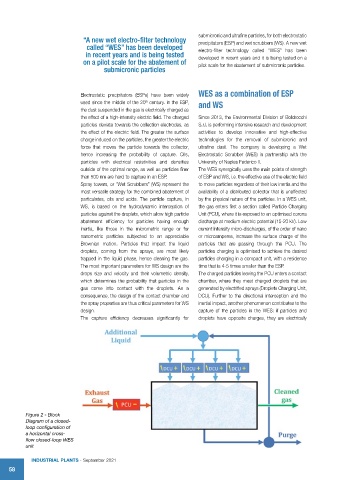
                             WS, is based on the hydrodynamic interception of   the gas enters first a section called Particle Charging
                             particles against the droplets, which allow high particle   Unit (PCU), where it is exposed to an optimised corona
                             abatement efficiency for particles having enough   discharge at medium electric potential (15-20 kV). Low
                             inertia, like those in the micrometric range or for   current intensity micro-discharges, of the order of nano
                             nanometric particles subjected to an appreciable   or microamperes, increase the surface charge of the
                             Brownian motion. Particles that impact the liquid   particles that are passing through the PCU. The
                             droplets, coming from the sprays, are most likely   particles charging is optimised to achieve the desired
                             trapped in the liquid phase, hence cleaning the gas.   particles charging in a compact unit, with a residence
                             The most important parameters for WS design are the   time that is 4-5 times smaller than the ESP.
                             drops  size  and  velocity  and  their  volumetric  density,   The charged particles leaving the PCU enters a contact
                             which determines the probability that particles in the   chamber, where they meet charged droplets that are
                             gas come into contact with the droplets. As a   generated by electrified sprays (Droplets Charging Unit,
                             consequence, the design of the contact chamber and   DCU). Further to the directional interception and the
                             the spray properties are thus critical parameters for WS   inertial impact, another phenomenon contributes to the
                             design.                                   capture of the particles in the WES: if particles and
                             The capture efficiency decreases significantly for   droplets have opposite charges, they are electrically


          Fi gure 2 - Block
          Diagram of a closed-
          loop configuration of
          a horizontal cross-
          flow closed-loop WES
          unit

            INDUSTRIAL PLANTS - September 2021
    58

