


Page 59 - Industrial Plants
P. 59
Wet electrostatic scr ubber (WES)


            development for the abatement


            of submicronic particles


            A new modern electro-filter technology jointly developed in recent
            years to fight PM emissions

            Luigi Amato, Project Leader, R&D
            Matteo Giavazzi, Head of Operations and Technology Development, Air Pollution Control Division,
            Boldrocchi Group

            Francesco Di Natale, Professor of Unit Operations and Sustainable Process Design,
            University of Naples Federico II


                ncreasingly frequent alarms due to the outbreak
                of threshold limits for fine particles in the
                atmosphere have been recorded in recent years.
                Particulate matters (PM) consist of solid or liquid
                particles  suspended  in  the  air  having  many
            Ishapes, sizes and chemical composition (10 nm
            – 100 μm). The largest of these can also be seen with
            the  naked  eye,  whereas others  can only be  seen
            through  powerful  microscopes.  These  suspended
            particles come from different sources such as natural
            phenomena or anthropic processes as combustion
            processes, industrial emissions, household activities,
            etc.
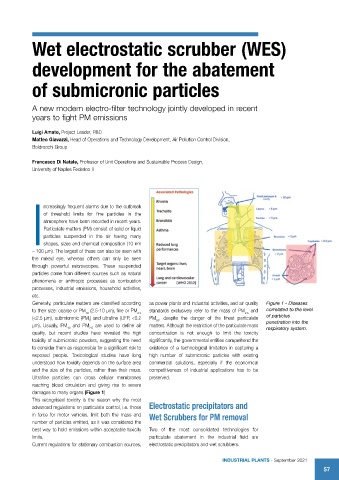
            Generally, particulate matters are classified according   as power plants and industrial activities, and air quality   F igure 1 - Diseases
            to their size: coarse or PM  (2.5-10 μm), fine or PM    standards exclusively refer to the mass of PM  and   correlated to the level
                               10                2.5                                   2.5
            (<2.5 μm), submicronic (PM ) and ultrafine (UFP, <0.2   PM , despite the danger of the finest particulate   of particles
                                1                       10                                     penetration into the
            μm).  Usually, PM   and  PM   are  used  to  define  air   matters. Although the restriction of the particulate mass
                         10     2.5                                                            respiratory system.
            quality, but recent studies have revealed the high   concentration is not enough to limit the toxicity
            toxicity of submicronic powders, suggesting the need   significantly, the governmental entities comprehend the
            to consider them as responsible for a significant risk to   existence of a technological limitation in capturing a
            exposed people. Toxicological studies have long   high number of submicronic particles with existing
            understood how toxicity depends on the surface area   commercial solutions, especially if the economical
            and the size of the particles, rather than their mass.   competitiveness of industrial applications has to be
            Ultrafine particles can cross cellular membranes   preserved.
            reaching blood circulation and giving rise to severe
            damages to many organs (Figure 1)
            This recognised toxicity is the reason why the most
            advanced regulations on particulate control, i.e. those  Electrostatic precipitators and
            in force for motor vehicles, limit both the mass and   Wet Scrubbers for PM removal
            number of particles emitted, as it was considered the
            best way to hold emissions within acceptable toxicity   Two of the most consolidated technologies for
            limits.                                  particulate abatement in the industrial field are
            Current regulations for stationary combustion sources,   electrostatic precipitators and wet scrubbers.

                                                                               INDUSTRIAL PLANTS - September 2021
                                                                                                                   57

