


Page 61 - Industrial Plants
P. 61
attracted to each other by improving the dust removal.
            The block diagram of a closed-loop WES configuration
            is shown in Figure 2 where a partial (>95%) recirculation
            of the liquid is included and additional water and purge
            streams are included to preserve system functioning
            and optimise particles capture performance.

            Figure 2 refers to the horizontal crossflow unit, that is
            currently adopted by Boldrocchi, but the WES can be
            designed using other configurations to optimise space
            occupancy and system performances for different
            industrial conditions.
            The electrified spray (ES) allows the generation of
            droplets having a defined surface electric charge. The
            droplets charge also take place at medium electric
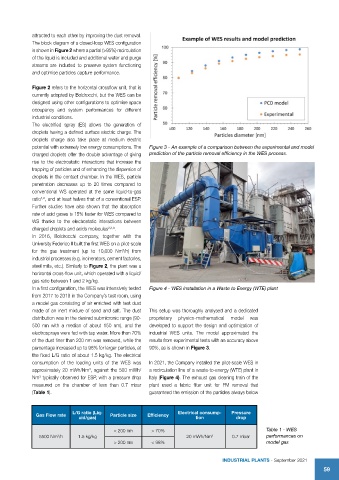
            potential with extremely low energy consumptions. The   Figure 3 - An example of a comparison between the experimental and model
            charged droplets offer the double advantage of giving   prediction of the particle removal efficiency in the WES process.
            rise to the electrostatic interactions that increase the
            trapping of particles and of enhancing the dispersion of
            droplets in the contact chamber. In the WES, particle
            penetration decreases up to 20 times compared to
            conventional WS operated at the same liquid-to-gas
            ratio , and at least halves that of a conventional ESP.
               1,2
            Further studies have also shown that the absorption
            rate of acid gases is 15% faster for WES compared to
            WS thanks to the electrostatic interactions between
            charged droplets and acids molecules 2,3,4 .
            In 2016, Boldrocchi company, together with the
            University Federico II built the first WES on a pilot-scale
                                            3
            for the gas treatment (up to 10,000 Nm /h) from
            industrial processes (e.g. incinerators, cement factories,
            steel mills, etc.). Similarly to Figure 2, the plant was a
            horizontal cross-flow unit, which operated with a liquid/
            gas ratio between 1 and 2 kg/kg.
            In a first configuration, the WES was intensively tested   Figure 4 - WES installation in a Waste to Energy (WTE) plant
            from 2017 to 2019 in the Company’s test room, using
            a model gas consisting of air enriched with test dust
            made of an inert mixture of sand and salt. The dust   This setup was thoroughly analysed and a dedicated
            distribution was in the desired submicronic range (90-  proprietary  physico-mathematical  model  was
            500 nm with a median of about 150 nm), and the   developed to support the design and optimization of
            electrosprays were fed with tap water. More than 70%   industrial WES units. The model approximated the
            of the dust finer than 200 nm was removed, while the   results from experimental tests with an accuracy above
            percentage increased up to 98% for larger particles, at   90%, as is shown in Figure 3.
            the fixed L/G ratio of about 1.5 kg/kg. The electrical
            consumption of the loading units of the WES was   In 2021, the Company installed the pilot-scale WES in
            approximately 20 mWh/Nm , against the 500 mWh/  a recirculation line of a waste-to-energy (WTE) plant in
                                3
            Nm  typically observed for ESP, with a pressure drop   Italy (Figure 4). The exhaust gas cleaning train of the
               3
            measured on the chamber of less than 0.7 mbar   plant used a fabric filter unit for PM removal that
            (Table 1).                               guaranteed the emission of the particles always below


                          L/G ratio (Liq-                       Electrical consump-  Pressure
              Gas Flow rate  uid/gas)   Particle size  Efficiency     tion          drop

                                         < 200 nm     > 70%                                    Table 1 - WES
               5500 Nm /h   1.5 kg/kg                             20 mWh/Nm 3      0.7 mbar    performances on
                     3
                                         > 200 nm     < 98%                                    model gas

                                                                               IndustrIal Plants - September 2021
                                                                                                                   59

