


Page 51 - Industrial Plants
P. 51
AMIU, the plant in the metropolitan city of Bari powered by OFMSW


              Owned by AMIU, the municipalised urban hygiene company that manages the waste collection,
              processing and disposal activities in the city of Bari (Apulia, Italy), the plant built by BTS Biogas in
              2020 has an installed power of 1,200 kW . The site, powered by OFMSW (Organic Fraction of
                                               el
              Municipal Solid Waste) mixed with other compostable waste fractions such as pruning cuttings, is
              able to produce electrical and thermal energy and soil fertilisers. It is one of the few plants
              constructed for the processing of organic waste in a metropolitan city, built to utilise organic waste
              and make a virtuous and sustainable waste disposal system available to citizens.
              The project involves AMIU collecting and transporting waste to the plant’s delivery areas, where the
              quality of the biomass is assessed: that which is not considered suitable is discarded. The plant is
              able to produce electricity or heat for self-consumption, with the surplus being sent into the
              network.


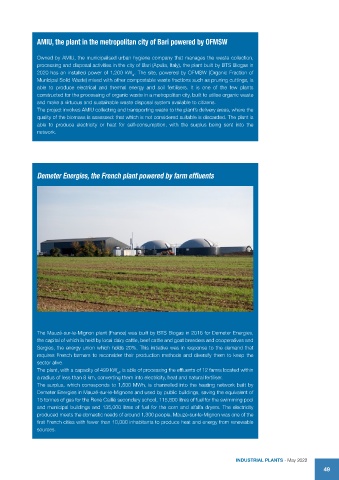
              Demeter Energies, the French plant powered by farm effluents


              The Mauzé-sur-le-Mignon plant (France) was built by BTS Biogas in 2016 for Demeter Energies,
              the capital of which is held by local dairy cattle, beef cattle and goat breeders and cooperatives and
              Sergies, the energy union which holds 20%. This initiative was in response to the demand that
              requires French farmers to reconsider their production methods and diversify them to keep the
              sector alive.
              The plant, with a capacity of 499 kW , is able of processing the effluents of 12 farms located within
                                          el
              a radius of less than 8 km, converting them into electricity, heat and natural fertiliser.
              The surplus, which corresponds to 1,500 MWh, is channelled into the heating network built by
              Demeter Energies in Mauzé-sur-le-Mignone and used by public buildings, saving the equivalent of
              15 tonnes of gas for the René Caillié secondary school, 115,800 litres of fuel for the swimming pool
              and municipal buildings and 135,000 litres of fuel for the corn and alfalfa dryers. The electricity
              produced meets the domestic needs of around 1,300 people. Mauzé-sur-le-Mignon was one of the
              first French cities with fewer than 10,000 inhabitants to produce heat and energy from renewable
              sources.


                                                                                    IndustrIal Plants - May 2022
                                                                                                                   49

