


Page 52 - Industrial Plants
P. 52
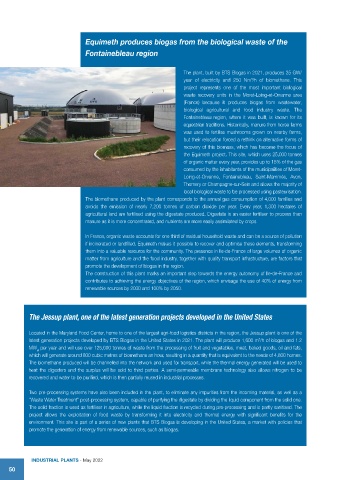
Equimeth produces biogas from the biological waste of the

                               Fontainebleau region


                                                                  The plant, built by BTS Biogas in 2021, produces 25 GW/
                                                                  year of electricity and 250 Nm /h of biomethane. This
                                                                                         3
                                                                  project represents one of the most important biological
                                                                  waste recovery units in the Moret-Loing-et-Orvanne area
                                                                  (France) because it produces biogas from wastewater,
                                                                  biological agricultural and food industry waste. The
                                                                  Fontainebleau region, where it was built, is known for its
                                                                  equestrian traditions. Historically, manure from horse farms
                                                                  was used to fertilise mushrooms grown on nearby farms,
                                                                  but their relocation forced a rethink on alternative forms of
                                                                  recovery of this biomass, which has become the focus of
                                                                  the Equimeth project. This site, which uses 25,000 tonnes
                                                                  of organic matter every year, provides up to 15% of the gas
                                                                  consumed by the inhabitants of the municipalities of Moret-
                                                                  Loing-et-Orvanne, Fontainebleau, Saint-Mammès, Avon,
                                                                  Thomery or Champagne-sur-Sein and allows the majority of
                                                                  local biological waste to be processed using pasteurisation.
                               The biomethane produced by the plant corresponds to the annual gas consumption of 4,000 families and
                               avoids the emission of nearly 7,200 tonnes of carbon dioxide per year. Every year, 1,300 hectares of
                               agricultural land are fertilised using the digestate produced. Digestate is an easier fertiliser to process than
                               manure as it is more concentrated, and nutrients are more easily assimilated by crops.

                               In France, organic waste accounts for one third of residual household waste and can be a source of pollution
                               if incinerated or landfilled. Equimeth makes it possible to recover and optimise these elements, transforming
                               them into a valuable resource for the community. The presence in Ile-de-France of large volumes of organic
                               matter from agriculture and the food industry, together with quality transport infrastructure, are factors that
                               promote the development of biogas in the region.
                               The construction of this plant marks an important step towards the energy autonomy of Ile-de-France and
                               contributes to achieving the energy objectives of the region, which envisage the use of 40% of energy from
                               renewable sources by 2030 and 100% by 2050.


           The Jessup plant, one of the latest generation projects developed in the United States


           Located in the Maryland Food Center, home to one of the largest agri-food logistics districts in the region, the Jessup plant is one of the
           latest generation projects developed by BTS Biogas in the United States in 2021. The plant will produce 1,600 m /h of biogas and 1.2
                                                                                            3
           MW  per year and will use over 125,000 tonnes of waste from the processing of fruit and vegetables, meat, baked goods, oil and fats,
              el
           which will generate around 800 cubic metres of biomethane an hour, resulting in a quantity that is equivalent to the needs of 4,800 homes.
           The biomethane produced will be channelled into the network and used for transport, while the thermal energy generated will be used to
           heat the digesters and the surplus will be sold to third parties. A semi-permeable membrane technology also allows nitrogen to be
           recovered and water to be purified, which is then partially reused in industrial processes.

           Two pre-processing systems have also been included in the plant, to eliminate any impurities from the incoming material, as well as a
           “Waste Water Treatment” post-processing system, capable of purifying the digestate by dividing the liquid component from the solid one.
           The solid fraction is used as fertiliser in agriculture, while the liquid fraction is recycled during pre-processing and is partly sanitised. The
           project allows the exploitation of food waste by transforming it into electricity and thermal energy with significant benefits for the
           environment. This site is part of a series of new plants that BTS Biogas is developing in the United States, a market with policies that
           promote the generation of energy from renewable sources, such as biogas.


            IndustrIal Plants - May 2022
    50

