


Page 57 - Industrial Plants
P. 57
critical speed is inside the critical operating range. This   d)  New HP and LP journal bearings
            could lead to vibration issues if the shaft is not properly   New HP and LP journal bearings with required reduced
            balanced or if the alignment is not properly done.   clearances according rotordynamic design (1,2‰
            Lateral analysis turbine side (high-speed shaft line) with   clearance), designed to improve stability and oil flow,
            new turbine bearings having 1,2‰ clearance.   having oil orifice inside the bearing housing.
            Improvements are visible:
            •   Steam turbine first critical speed is still well below   e)  New thrust bearing
                critical operating range, and second critical speed   New thrust bearing, designed to withstand the axial
                is still well above the same.        forces all over the operating range of the turbine,
            •   Intermediate shaft first critical speed is now   avoiding overheating or load limitation
                outside the critical operating range (above
                operating speed +15%)                The retrofit will allow to upgrade quite considerably the
            •   Generator first  and  second  critical  speeds  are   power output and thermal efficiency, given the same
                between the 1x and  2x operational  speed and   load conditions, in detail:
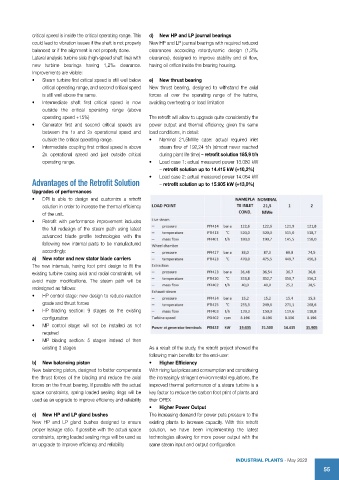
                outside the critical operating range.   •   Nominal  21,5MWe  case:  actual  required  inlet
            •   Intermediate coupling first critical speed is above   steam flow of 192,24 t/h (almost never reached
                2x operational speed and just outside critical   during plant life time) – retrofit solution 185,9 t/h
                operating range.                     •   Load case 1: actual measured power 13.080 kW
                                                         – retrofit solution up to 14.415 kW (+10,2%)
                                                     •   Load case 2: actual measured power 14.064 kW
            Advantages of the Retrofit Solution          – retrofit solution up to 15.905 kW (+13,0%)
            Upgrades of performances
            •   DPI is able to design and customize a retrofit
                solution in order to increase the thermal efficiency
                of the unit.
            •   Retrofit with performance improvement includes
                the full redesign of the steam path using latest
                advanced blade profile technologies with the
                following new internal parts to be manufactured
                accordingly:
            a)   New rotor and new stator blade carriers
            The new internals, having foot print design to fit the
            existing turbine casing axial and radial constraints, will
            avoid major modifications. The steam path will be
            redesigned as follows:
            •   HP control stage: new design to reduce reaction
                grade and thrust forces
            •   HP blading section: 9 stages as the existing
                configuration
            •   MP control stage: will not be installed as not
                required
            •   MP blading section: 5 stages instead of then
                existing 3 stages                    As a result of the study, the retrofit project showed the
                                                     following main benefits for the end-user:
            b)   New balancing piston                •   Higher Efficiency
            New balancing piston, designed to better compensate   With rising fuel prices and consumption and considering
            the thrust forces of the blading and reduce the axial   the increasingly stringent environmental regulations, the
            forces on the thrust bearing. If possible with the actual   improved thermal performance of a steam turbine is a
            space constraints, spring loaded sealing rings will be   key factor to reduce the carbon foot print of plants and
            used as an upgrade to improve efficiency and reliability  their OPEX
                                                     •   Higher Power Output
            c)  New HP and LP gland bushes           The increasing demand for power puts pressure to the
            New  HP and LP  gland  bushes designed to  ensure   existing plants to increase capacity. With this retrofit
            proper leakage ratio. If possible with the actual space   solution, we have been implementing the latest
            constraints, spring loaded sealing rings will be used as   technologies allowing for more power output with the
            an upgrade to improve efficiency and reliability  same steam input and output configuration.

                                                                                    IndustrIal Plants - May 2022
                                                                                                                   55

