


Page 33 - Impiantistica italiana
P. 33
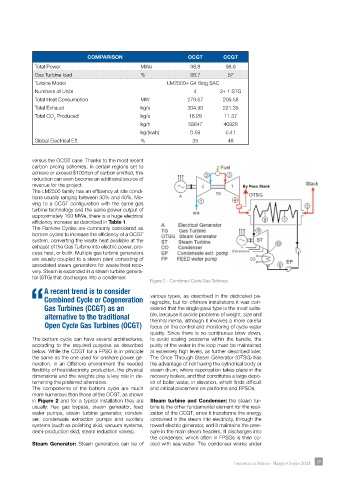
COMPARISON                         OCGT        CCGT
             Total Power                          MWe               98.8        98.8
             Gas Turbine load                     %                 88.7         87
             Turbine Model                                  LM2500+ G4 6stg SAC
             Numbers of Units                                        4        3+ 1 STG
             Total Heat Consumption               MW               279.67      206.58
             Total Exhaust                        kg/s             304.90      221.35
             Total CO  Produced                   kg/s             16.29        11.37
                    2
                                                  kg/h             58647        40928
                                                  kg/(kwh)          0.59        0.41
             Global Electrical Eff.               %                  35          48


            versus the OCGT case. Thanks to the most recent
            carbon pricing schemes, in certain regions set to
            achieve or exceed $100/ton of carbon emitted, this
            reduction can even become an additional source of
            revenue for the project.
            The LM2500 family has an efficiency at site condi-
            tions usually ranging between 30% and 40%. Mo-
            ving to a CCGT configuration with the same gas
            turbine technology and the same power output of
            approximately 100 MWe, there is a huge electrical
            efficiency increase as described in Table 1.
            The Rankine Cycles are commonly considered as
            bottom cycles to increase the efficiency of a OCGT
            system, converting the waste heat available at the
            exhaust of the Gas Turbine into electric power, pro-
            cess heat, or both. Multiple gas turbine generators
            are usually coupled to a steam plant consisting of
            associated steam generators for waste heat reco-
            very. Steam is expanded in a steam turbine genera-
            tor (STG) that discharges into a condenser.
                                                      Figure 2 - Combined Cycle Gas Turbines
                 A recent trend is to consider
                 Combined Cycle or Cogeneration       various types, as described in the dedicated pa-
                                                      ragraphs, but for offshore installations it was con-
            “Gas Turbines (CCGT) as an                sidered that the single-pass type is the most suita-
                 alternative to the traditional       ble, because it avoids problems of weight, size and
                                                      thermal inertia, although it involves a more careful
                 Open Cycle Gas Turbines (OCGT)       focus on the control and monitoring of cycle water
                                                      quality. Since there is no continuous blow down,
            The bottom cycle can have several architectures,   to avoid scaling problems within the bundle, the
            according to the required purpose as described   purity of the water in the loop must be maintained
            below. While the CCGT for a FPSO is in principle   at extremely high levels, as further described later.
            the same as the one used for onshore power ge-  The Once Through Steam Generator (OTSG) has
            neration, in an Offshore environment the needed   the advantage of not having the cylindrical body or
            flexibility of heat/electricity production, the physical   steam drum, where vaporization takes place in the
            dimensions and the weights play a key role in de-  recovery boilers, and that constitutes a large depo-
            termining the preferred alternative.      sit of boiler water, in elevation, which finds difficult
            The components of the bottom cycle are much   and critical placement on platforms and FPSOs.
            more numerous than those of the OCGT, as shown
            in Figure 2 and for a typical installation they are   Steam turbine and Condenser: the steam tur-
            usually: flue gas bypass, steam generator, feed   bine is the other fundamental element for the reali-
            water  pumps,  steam turbine  generator, conden-  zation of the CCGT, since it transforms the energy
            ser, condensate extraction pumps and auxiliary   contained in the steam into electricity, through the
            systems (such as polishing skid, vacuum systems,   towed electric generator, and it maintains the pres-
            demi-production skid, steam reduction valves).  sure in the main steam headers. It discharges into
                                                      the condenser, which often in FPSOs is then co-
            Steam  Generator:  Steam  generators  can  be  of   oled with sea water. The condenser works under


                                                                                   Impiantistica Italiana - Maggio-Giugno 2024  29

