


Page 34 - Impiantistica italiana
P. 34
ENERGY TRANSITION


                            vacuum to exploit all the energy contained in the   the high temperature systems is not an issue for
                            steam. The steam, that expands in the turbine, can   the CCGT, due to the possibility of operating the
                            also be tapped (bleeds) or extracted to feed ther-  gas turbines also in OCGT mode during transients
                            mal utilities (i.e. thermal transfer fluid heat exchan-  and start/stop. Further, high flexibility in heat avai-
                            gers) that need heat.                     lability is provided by the steam let-down valves,
                            Generally, the steam, extracted and condensed in   which allow the heat exchangers to be suddenly
                            the heat exchangers, returns to the condenser to   supplied with low-pressure steam.
                            close the loop and also the fresh make-up water,   This flexibility of steam production and electricity is
                            necessary to recover the losses of the circuit, is fed   very important during the transients of FPSO pro-
                            into the condenser.                       cess plant, like start up or partial shutdown, and to
                                                                      match the product variation of reservoir during oil/
                            Flexibility in power and heat production. In Of-  gas field operational life.
                            fshore, the split of power/heat demand changes
                            with the operating conditions of the plant, and the   High efficiency and lower CO  emission. As
                                                                                                2
                            ability to change these loads is a critical require-  shown in Table 1, heat recovery at the gas turbi-
                            ment. This flexibility is well provided by steam pro-  ne exhaust limits the amount of energy lost to the
                            duction from a waste heat generator and by using   atmosphere and increases overall efficiency (i.e.:
                            steam in a (condensing) steam turbine. In effect,   from  35%  to  48% in  the  case  considered).  As  a
                            the electricity is produced by the driven electrical   direct consequence, there is also a significant re-
                            generator, while the heat comes from the extrac-  duction in CO  emissions per kWh produced (from
                                                                                2
                            tion/ bleeding as required.               0.59 to 0.41 kg/kWh).
                            This system also provides the ability to use more
                            steam in the turbine when heat demand is low and,
                            conversely, to use less steam in the turbine, when
                            the heat demand is higher.                Plant architectures
                            Furthermore, any load change limitation caused by
                            either the thermal inertia of the steam generator or   CCGT Configurations
                                                                      The overall efficiency of a CCGT, calculated as to-
                                                                      tal net electric or mechanical power vs heat rate,
                                                                      increases with the complexity of the bottom cycle
                                                                      selected. The maximum energy conversion is pos-
                                                                      sible with Steam generated at three pressure levels
                                                                      with reheating steam turbine arrangement. Howe-
                                                                      ver, this is not an optimal solution for power gene-
                                                                      ration on FPSO plants that must be characterized
                                                                      by reduced size, high flexibility and powered by
                                                                      aero-derivative gas turbines. Therefore, the prefer-
                                                                      red cycle architecture in FPSO is usually with single
                                                                      steam pressure level that has lower heating reco-
                                                                      very,  higher  temperature  at the  stack,  that  could
                                                                      be requested in case of sulphur gas/liquid fuel, as
                                                                      indicated ahead.
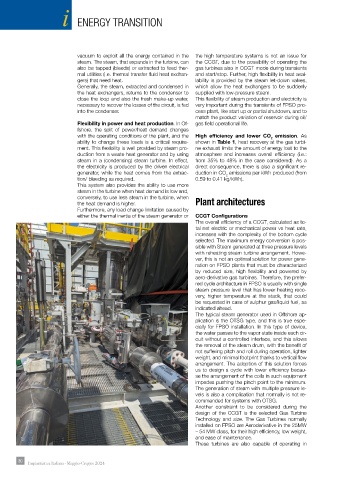
                                                                      The typical steam generator used in Offshore ap-
                                                                      plication is the OTSG type, and this is true espe-
                                                                      cially for FPSO installation. In this type of device,
                                                                      the water passes to the vapor state inside each cir-
                                                                      cuit without a controlled interface, and this allows
                                                                      the removal of the steam drum, with the benefit of
                                                                      not suffering pitch and roll during operation, lighter
                                                                      weight, and minimal footprint thanks to vertical flow
                                                                      arrangement. The adoption of this solution forces
                                                                      us to design a cycle with lower efficiency becau-
                                                                      se the arrangement of the coils in such equipment
                                                                      impedes pushing the pinch point to the minimum.
                                                                      The generation of steam with multiple pressure le-
                                                                      vels is also a complication that normally is not re-
                                                                      commended for systems with OTSG.
                                                                      Another  constraint  to  be  considered  during  the
                                                                      design of the CCGT is the selected Gas Turbine
                                                                      Technology  and  size.  The  Gas  Turbines  normally
                                                                      installed on FPSO are Aeroderivative in the 25MW
                                                                      – 54 MW class, for their high efficiency, low weight,
                                                                      and ease of maintenance.
                                                                      These turbines are also capable of operating in


       30  Impiantistica Italiana - Maggio-Giugno 2024

