


Page 35 - Impiantistica italiana
P. 35
dual fuel mode, diesel and natural gas,
            the latter produced as by-product from
            the process facilities, and therefore with
            lower quality (often with high sulphur con-
            tent).
            The energy conversion of the CCGT is
            normally reduced by the quality of the fuel
            because the temperature’s margin from
            the Acid Dew point to be maintained at
            the stack, often above 140°C.
            In addition, since the power plant will be
            operated in island mode with various am-
            bient temperatures and grid loads, the
            Gas Turbines unlikely will be operated at
            baseload. This is an additional constrain
            that need to be considered when desi-
            gning the bottoming cycle.
            The optimization of a combined cycle
            needs a specifi c sensitivity study and is
            based on the design envelope given for
            each specifi c application.
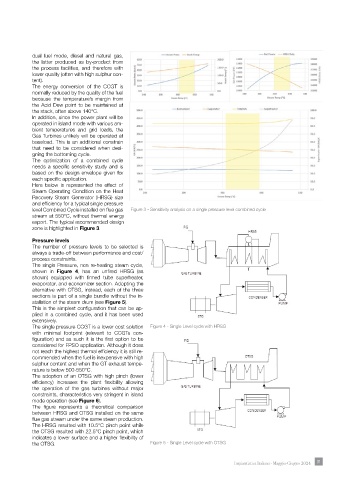
            Here  below  is  represented  the  effect  of
            Steam Operating Condition on the Heat
            Recovery Steam Generator (HRSG) size
            and effi ciency for a typical single pressure
            level Combined Cycle installed on fl ue gas   F igure 3 - Sensitivity analysis on a single pressure level combined cycle
            stream at 550°C, without thermal energy
            export. The typical recommended design
            zone is highlighted in Figure 3.

            Pressure levels
            The number of pressure levels to be selected is
            always a trade-off between performance and cost/
            process constraints.
            The single Pressure, non re-heating steam cycle,
            shown  in  Figure  4,  has  an  unfi red  HRSG  (as
            shown) equipped with fi nned tube superheater,
            evaporator, and economizer section. Adopting the
            alternative with OTSG, instead, each of the three
            sections is part of a single bundle without the in-
            stallation of the steam drum (see Figure 5).
            This is the simplest confi guration that can be ap-
            plied in a combined cycle, and it has been used
            extensively.
            The single pressure CCGT is a lower cost solution   Figure 4 - Single Level cycle with HRSG
            with minimal footprint (relevant to CCGTs con-
            fi guration) and as such it is the fi rst option to be
            considered for FPSO application. Although it does
            not reach the highest thermal effi ciency it is still re-
            commended when the fuel is inexpensive with high
            sulphur content and when the GT exhaust tempe-
            rature is below 500-550°C.
            The adoption of an OTSG with high pinch (lower
            effi ciency)  increases  the  plant  fl exibility  allowing
            the operation of the gas turbines without major
            constraints, characteristics very stringent in island
            mode operation (see Figure 6).
            The fi gure represents a theoretical comparison
            between HRSG and OTSG installed on the same
            fl ue gas stream under the same steam production.
            The HRSG resulted with 10.5°C pinch point while
            the OTSG resulted with 22.5°C pinch point, which
            indicates a lower surface and a higher fl exibility of
            the OTSG.                                 Figure 5 - Single Level cycle with OTSG


                                                                                   Impiantistica Italiana - Maggio-Giugno 2024  31

