


Page 27 - 77
P. 27
as templates. In software, the unit cost is close to
            nil. Adobe, for example, takes some financial risk in
            releasing Creative Cloud for the price of a monthly
            payment rather than the license fee of its compa-
            rable on-site software. But it doesn’t have to ship
            individual pieces of machinery that cost thousan-
            ds, or millions, of dollars to produce—a greater risk
            than sharing code. Revenue disruption at this scale
            could lead to a more sustainable income stream,
            but if anything were to go wrong the financial re-
            sults could be devastating.

            Still, given the potential that sellers and buyers see
            in this pricing model, there’s a strong incentive to
            make it work for all parties. In our work with com-
            panies trying to get this right, three main obstacles
            slow their progress:
            •   agreeing with customers on the value created
                and how to share risk;
            •   managing the internal changes required to sup-
                port a service pricing model; and
            •   “swallowing the fish”—planning for a disrupti-
                ve period of rising costs and falling revenues,
                before the financials find their new trajectory

            When executive teams understand the risks and
            opportunities of the equipment as a service (EaaS)
            pricing model, they can develop offers that work for
            buyers and sellers, limiting exposure and maximi-
            zing the gains for both sides.
                 Makers and sellers of industrial
                 equipment and machinery              Fig. 1- 2
            “would like to
                 capture more value from their        based on operational or financial achievements,
                 wares by retaining ownership         can deliver more value to suppliers—providing they
                 and charging customers for           can assess and measure that value accurately.
                 subscription rates. But the          •   Operational outcomes. This model is good for
                 transition to this model has            solutions that perform well-defined discrete ta-
                 been slow, reflecting the                sks, such as industrial robotics or automation
                                                         equipment. One  warehouse robotics provider
                 difficulty in pricing accurately         charges per cycle, where each cycle is defined
                                                         as picking a carton, bringing it to a packing area
            Determining the best pricing                 and returning the carton to its original location.
            model                                     •   Financial outcomes.  This model works well
                                                         when you can establish a direct link between
            Manufacturers have been trying to develop service   the  equipment  and measurable  financial  re-
            lines that deliver more reliable streams of revenue   sults. A supplier of compressed natural  gas
            for  decades.  Equipment  as  a  service  represents   systems for fuel stations found that station
            the ultimate pathway to getting there: As long as   operators were put off by the high capital costs
            the machines  are running, revenue  continues  to   for the compressor and related hardware nee-
            flow and suppliers share in more of the value that   ded to deliver the gas to vehicles. The supplier
            the equipment delivers for customers. Some of that   switched to a model where stations receive
            value comes as it would with any service contract,   the compressor and hardware and then pay
            but additional value can also come from the sup-  fees based on the volume of gas sold. In this
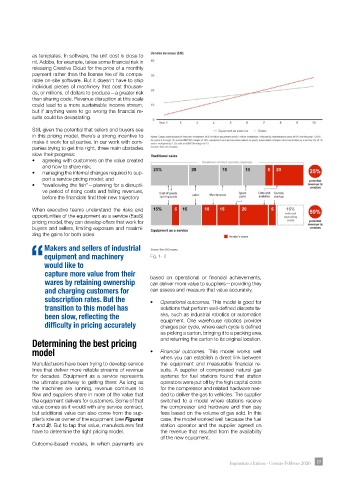
            plier’s role as owner of the equipment (see Figures   case, the model worked well because the fuel
            1 and 2). But to tap that value, manufacturers first   station operator and the supplier agreed on
            have to determine the right pricing model.   the revenue that resulted from the availability
                                                         of the new equipment.
            Outcome-based models, in which payments are


                                                                                  Impiantistica Italiana - Gennaio-Febbraio 2020  23

