


Page 22 - 77
P. 22
FuTurE MobIlITy


                            tric vehicles will decrease, which will in turn drive
                            sales. Improved batteries would extend the vehicle   The MIT Energy Initiative (MITEI) is MIT’s hub
                            range, reinforcing the attractiveness of alternative   for energy research, education, and outreach—
                            fuel vehicles to consumers. Greater deployment of   connecting faculty, students, and staff to develop
                            electric vehicles creates a larger market for publicly   the technologies and solutions
                            available charging infrastructure, which is critical   that will deliver clean, afforda-
                            for supporting charging convenience. Early go-  ble, and plentiful sources of
                            vernment support for alternative fuel vehicles and   energy. MITEI’s mission is to
                            charging and fueling infrastructure can help launch   develop low- and no-carbon
                            a self-reinforcing trajectory of adoption—and has   solutions that will efficiently and
                            already contributed to an increase in alternative fuel   sustainably meet global energy
                            vehicle deployment.                        needs while minimizing environmental impacts,
                                                                       dramatically  reducing  greenhouse  gas  emis-
                                                                       sions, and mitigating climate change.


                                                                      reach total cost-of-ownership parity with internal
                                                                      combustion engine vehicles in approximately 10
                                                                      years in the U.S. It should also lead to new busi-
                                                                      ness opportunities, including solutions for develo-
                                                                      ping cost-effective methods of recycling batteries
                                                                      on an industrial scale.

                                                                      Consumer attitudes


                                                                      The researchers also examined the role of consu-
                                                                      mer attitudes toward car ownership and use in both
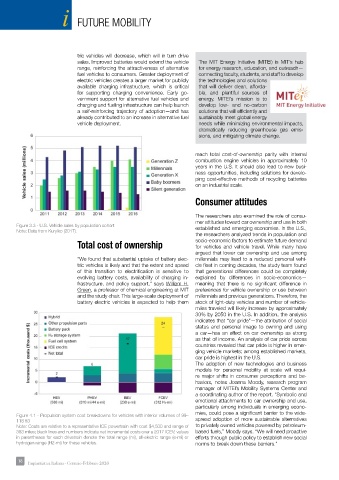
       Figure 3.3 - U.S. Vehicle sales by population cohort           established and emerging economies. In the U.S.,
       Note: Data from Kurylko (2017).
                                                                      the researchers analyzed trends in population and
                            Total cost of ownership                   socio-economic factors to estimate future demand
                                                                      for vehicles and vehicle travel. While many have
                                                                      argued that lower car ownership and use among
                            “We found that substantial uptake of battery elec-  millennials  may  lead  to  a reduced personal  vehi-
                            tric vehicles is likely and that the extent and speed   cle fleet in coming decades, the study team found
                            of this transition to electrification is sensitive to   that generational differences could be completely
                            evolving battery costs, availability of charging in-  explained by differences in socio-economics—
                            frastructure, and policy support,” says William H.   meaning that there is no significant difference in
                            Green, a professor of chemical engineering at MIT   preferences for vehicle ownership or use between
                            and the study chair. This large-scale deployment of   millennials and previous generations. Therefore, the
                            battery electric vehicles is expected to help them   stock of light-duty vehicles and number of vehicle-
                                                                      miles traveled will likely increase by approximately
                                                                      30% by 2050 in the U.S. In addition, the analysis
                                                                      indicates that “car pride”—the attribution of social
                                                                      status and personal image to owning and using
                                                                      a car—has an effect on car ownership as strong
                                                                      as that of income. An analysis of car pride across
                                                                      countries revealed that car pride is higher in emer-
                                                                      ging vehicle markets; among established markets,
                                                                      car pride is highest in the U.S.
                                                                      The adoption of new technologies and business
                                                                      models for personal mobility at scale  will requi-
                                                                      re major shifts in consumer perceptions and be-
                                                                      haviors, notes Joanna Moody, research program
                                                                      manager of MITEI’s Mobility Systems Center and
                                                                      a coordinating author of the report. “Symbolic and
                                                                      emotional attachments to car ownership and use,
                                                                      particularly among individuals in emerging econo-
                                                                      mies, could pose a significant barrier to the wide-
       Figure 4.1 - Propulsion system cost breakdowns for vehicles with interior volumes of 99–
       118 ft3                                                        spread adoption of more sustainable alternatives
       Note: Costs are relative to a representative ICE powertrain with cost $4,500 and range of   to privately owned vehicles powered by petroleum-
       383 miles; black lines and numbers indicate net incremental costs over a 2017 ICEV; values   based fuels,” Moody says. “We will need proactive
       in parentheses for each drivetrain denote the total range (mi), all-electric range (e-mi) or   efforts through public policy to establish new social
       hydrogen range (H2-mi) for these vehicles.                     norms to break down these barriers.”


       18 18  Impiantistica Italiana - Gennaio-Febbraio 2020

