


Page 32 - 77
P. 32
technology


                            progressive stricter regulations in order to control
                            emissions of sulphur oxides and nitrous oxides.
                            North America and much of northern Europe are
                            currently Emission Control Areas. Burning natural
                            gas produces negligible amounts of sulphur oxi-
                            des, particulates and nitrous oxides, so LNG is a
                            perfect fuel candidate to be used for marine tran-
                            sport.

                            LNG distribution for small off-grid gas users and in
                            road fuelling stations is also in rapid growth.

                            The  availability  of  Small  Scale  LNG  solutions  is
                            crucial to support the evolution of LNG as a fuel,
                            and  a  dilemma  remains  between  the  level  of
                            LNG demand and the availability of small quanti-
                            ties of LNG, competitive with other types of fuels.
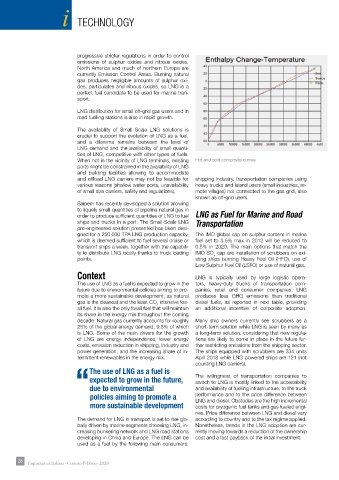
                            When not in the vicinity of LNG terminals, existing   Hot and cold composite curves      1
                            ports might be constrained in the availability of LNG
                            and building facilities allowing to accommodate
                            and offl oad LNG carriers may not be feasible for   shipping industry, transportation companies using
                            various reasons (shallow water ports, unavailability   heavy trucks and island users (small industries, re-
                            of small size carriers, safety and regulations).  mote villages) not connected to the gas grid, also
                                                                      known as off-grid users.
                            Saipem has recently developed a solution allowing
                            to liquefy small quantities of pipeline natural gas in
                            order to produce suffi cient quantities of LNG to fuel  LNG as Fuel for Marine and Road
                            ships and trucks in a port. The Small-Scale LNG   Transportation
                            pre-engineered solution presented has been desi-
                            gned for a 250,000 TPA LNG production capacity,   The IMO global cap on sulphur content in marine
                            which is deemed suffi cient to fuel several cruise or   fuel set to 3.5% max in 2012 will be reduced to
                            transport ships a week, together with the capabili-  0.5% in 2020. The main options that match the
                            ty to distribute LNG locally thanks to truck loading   IMO SO  cap are installation of scrubbers on exi-
                                                                            x
                            points.                                   sting ships burning Heavy Fuel Oil (HFO), use of
                                                                      Low Sulphur Fuel Oil (LSFO) or use of natural gas.
                            Context                                   LNG is typically used by large logistic opera-

                            The use of LNG as a fuel is expected to grow in the   tors, heavy-duty trucks of transportation com-
                            future due to environmental policies aiming to pro-  panies, retail and consumer companies. LNG
                            mote a more sustainable development, as natural   produces  less  GHG emissions than  traditional
                            gas is the cleanest and the least CO  intensive fos-  diesel fuels, as reported in next table, providing
                                                        2
                            sil fuel. It is also the only fossil fuel that will maintain   an additional incentive of corporate adoption.
                            its share in the energy mix throughout the coming
                            decade. Natural gas currently accounts for roughly   Many ship owners currently see scrubbers as a
                            25% of the global energy demand, 9.8% of which   short-term solution while LNG is seen by many as
                            is LNG. Some of the main drivers for the growth   a long-term solution, considering that new regula-
                            of  LNG  are  energy  independence,  lower  energy   tions are likely to come in place in the future fur-
                            costs, emission reduction in shipping, industry and   ther restricting emissions from the shipping sector.
                            power generation, and the increasing share of in-  The ships equipped with scrubbers are 334 units
                            termittent renewables in the energy mix.   April 2018 while LNG powered ships are 121 (not
                                                                      counting LNG carriers).
                                The use of LNG as a fuel is
                                expected to grow in the future,       The willingness of transportation companies to
                                                                      switch to LNG is mostly linked to the accessibility
                           “due to environmental                      and availability of fuelling infrastructure, to the truck
                                 policies aiming to promote a         performance and to the price difference between
                                                                      LNG and diesel. Obstacles are the high incremental
                                 more sustainable development         costs for cryogenic fuel tanks and gas fuelled engi-
                                                                      nes. Price difference between LNG and diesel vary
                            The demand for LNG in transport is set to rise glo-  according to country and to the tax regime applied.
                            bally driven by marine segments choosing LNG, in-  Nonetheless, trends in the LNG adoption are cur-
                            creasing bunkering network and LNG road stations   rently moving towards a reduction of the ownership
                            developing in China and Europe. The LNG can be   cost and a fast payback of the initial investment.
                            used as a fuel by the following main consumers:


       28 28  Impiantistica Italiana - Gennaio-Febbraio 2020

