


Page 49 - Impiantistica Industriale
P. 49
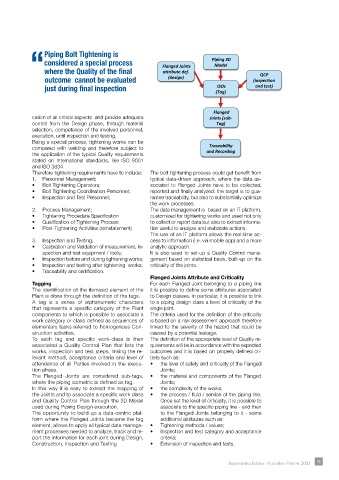
Piping Bolt Tightening is
                 considered a special process              Flanged Joints    Piping 3D
                                                                            Model
            “where the Quality of the fi nal              attribute def.                    QCP
                 outcome  cannot be evaluated               (design)                      (inspection
                 just during final inspection                                 ISOs         and test)

                                                                             (Tag)


                                                                             Flanged
            cation of all critical aspects  and provide adequate           Joints (sub-
            control  from  the  Design  phase,  through  material            Tag)
            selection, competence of the involved personnel,
            execution, until inspection and testing.
            Being a special process, tightening works can be
            compared with welding and therefore subject to                Traceability
            the application of the typical Quality requirements           and Recording
            stated on International standards, like ISO 9001
            and ISO 3834.
            Therefore tightening requirements have to include:  The bolt tightening process could get benefi t from   CONFIDENTIAL
            1.  Personnel Management;                 typical data-driven approach, where the data as-
            •   Bolt Tightening Operators;            sociated to Flanged Joints have to be collected,
            •   Bolt Tightening Coordination Personnel;   reported and fi nally analyzed: the target is to gua-
            •   Inspection and Test Personnel;        rantee traceability, but also to substantially optimize
                                                      the work processes.
            2.  Process Management;                   The data management is  based on an IT platform,
            •   Tightening Procedure Specifi cation   customized for tightening works and used not only
            •   Qualifi cation of Tightening Process   to collect or report data but also to extract informa-
            •   Post-Tightening Activities (reinstatement)  tion useful to analyze and elaborate actions.
                                                      The use of an IT platform allows the real-time ac-
            3.  Inspection and Testing;               cess to information (i.e. via mobile app) and a more
            •   Calibration and Validation of measurement, in-  analytic approach.
                spection and test equipment / tools;  It is also used to set-up a Quality Control mana-
            •   Inspection before and during tightening works;   gement based on statistical basis, built-up on the
            •   Inspection and testing after tightening  works;  criticality of the joints.
            •   Traceability and certifi cation.
                                                      Flanged Joints Attribute and Criticality
            Tagging                                   For each Flanged Joint belonging to a piping line
            The identifi cation of the itemized element of the   it is possible to defi ne some attributes associated
            Plant is done through the defi nition of the tags.   to Design classes. In particular, it is possible to link
            A  tag is a  series of  alphanumeric  characters   to a piping design class a level of criticality of the
            that represents a specifi c category of the Plant   single joint.
            components to which is possible to associate a   The criteria used for the defi nition of the criticality
            work category or class defi ned as sequences of   is based on a risk assessment approach therefore
            elementary tasks referred to homogenous Con-  linked to the severity of the hazard that could be
            struction activities.                     caused by a potential leakage.
            To each tag and specifi c work-class is then   The defi nition of the appropriate level of Quality re-
            associated a Quality Control Plan that lists the   quirements will be in accordance with the expected
            works, inspection and test steps, linking the re-  outcomes and it is based on properly defi ned cri-
            levant method, acceptance criteria and level of   teria such as:
            attendance of all Parties involved in the execu-  •   the level of safety and criticality of the Flanged
            tion phase.                                  Joints;
            The Flanged Joints are considered sub-tags,   •   the material and components of the Flanged
            where the piping isometric is defi ned as tag.  Joints;
            In this way it is easy to extract the mapping of   •   the complexity of the works;
            the Joints and to associate a specifi c work class   •   the process / fl uid / service of the piping line.
            and Quality Control Plan through the 3D Model   Once set the level of criticality, it is possible to
            used during Piping Design execution.         associate to the specifi c piping line - and then
            The opportunity to build-up a data-centric plat-  to the Flanged Joints belonging to it - some
            form where the Flanged Joints became the tag   additional attributes such as:
            element, allows to apply all typical data manage-  •   Tightening methods / values;
            ment processes needed to analyze, track and re-  •   Inspection and test category and acceptance
            port the information for each joint during Design,   criteria;
            Construction, Inspection and Testing      •   Extension of inspection and tests.


                                                                                 Impiantistica Italiana - Settembre-Ottobre 2021  45

