


Page 78 - 95
P. 78
TECHNOLOGIES


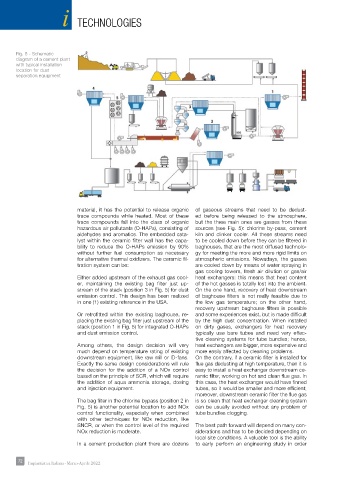
       Fig. 5 - Schematic
       diagram of a cement plant
       with typical installation
       location for dust
       separation equipment


                            material, it has the potential to release organic   of gaseous streams that need to be dedust-
                            trace compounds while heated. Most of these   ed before being released to the atmosphere,
                            trace compounds fall into the class of organic   but the three main ones are gasses from these
                            hazardous air pollutants (O-HAPs), consisting of   sources (see Fig. 5): chlorine by-pass, cement
                            aldehydes and aromatics. The embedded cata-  kiln and clinker cooler. All these streams need
                            lyst within the ceramic filter wall has the capa-  to be cooled down before they can be filtered in
                            bility to reduce the O-HAPs emission by 90%   baghouses, that are the most diffused technolo-
                            without further fuel consumption  as necessary   gy for meeting the more and more rigid limits on
                            for alternative thermal oxidizers. The ceramic fil-  atmospheric  emissions.  Nowadays,  the  gasses
                            tration system can be:                    are cooled down by means of water spraying in
                                                                      gas cooling towers, fresh air dilution or gas/air
                            Either added upstream of the exhaust gas cool-  heat exchangers: this means that heat content
                            er, maintaining the existing bag filter just up-  of the hot gasses is totally lost into the ambient.
                            stream of the stack (position 3 in Fig. 5) for dust   On the one hand, recovery of heat downstream
                            emission control. This design has been realized   of baghouse filters is not really feasible due to
                            in one (1) existing reference in the USA.  the low gas temperature; on the other hand,
                                                                      recovery upstream baghouse filters is possible
                            Or retrofitted within the existing baghouse, re-  and some experiences exist, but is made difficult
                            placing the existing bag filter just upstream of the   by the high dust concentration. When installed
                            stack (position 1 in Fig. 5) for integrated O-HAPs   on dirty gases, exchangers for heat recovery
                            and dust emission control.                typically use bare tubes and need very effec-
                                                                      tive cleaning systems for tube bundles; hence,
                            Among others, the design decision will very   heat exchangers are bigger, more expensive and
                            much depend on temperature rating of existing   more easily affected by cleaning problems.
                            downstream equipment, like raw mill or ID-fans.   On the contrary, if a ceramic filter is installed for
                            Exactly the same design considerations will rule   flue gas dedusting at high temperature, then it is
                            the  decision  for  the  addition  of  a  NOx  control   easy to install a heat exchanger downstream ce-
                            based on the principle of SCR, which will require   ramic filter, working on hot and clean flue gas. In
                            the addition of aqua ammonia storage, dosing   this case, the heat exchanger would have finned
                            and injection equipment.                  tubes, so it would be smaller and more efficient;
                                                                      moreover, downstream ceramic filter the flue gas
                            The bag filter in the chlorine bypass (position 2 in   is so clean that heat exchanger cleaning system
                            Fig. 5) is another potential location to add NOx   can be usually avoided without any problem of
                            control functionality, especially when combined   tube bundles clogging.
                            with other techniques for NOx reduction, like
                            SNCR, or when the control level of the required   The best path forward will depend on many con-
                            NOx reduction is moderate.                siderations and has to be decided depending on
                                                                      local site conditions. A valuable tool is the ability
                            In a cement production plant there are dozens   to early perform an engineering study in order


       72 72  Impiantistica Italiana - Marzo-Aprile 2022

