


Page 77 - 95
P. 77
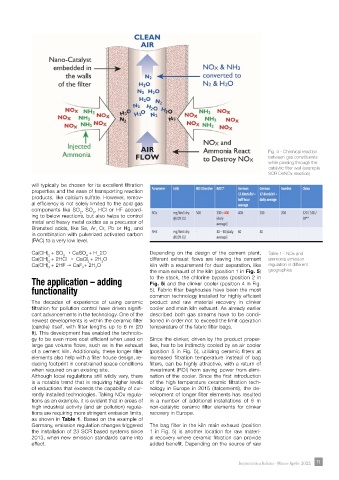
Fig. 4 - Chemical reaction
                                                                                               between gas constituents
                                                                                               while passing through the
                                                                                               catalytic filter wall (example
                                                                                               SCR DeNOx reaction)

            will typically be chosen for its excellent filtration
            properties and the ease of transporting reaction
            products, like calcium sulfate. However, remov-
            al efficiency is not solely limited to the acid gas
            components like SO , SO , HCl or HF accord-
                                  3
                             2
            ing to below reactions, but also helps to control
            metal and heavy metal oxides as a precursor of
            Brønsted acids, like Se, Ar, Cr, Pb or Hg, and
            in combination with pulverized activated carbon
            (PAC) to a very low level.

            Ca(OH) + SO  → CaSO + H_2O                Depending on the design of the cement plant,   Table 1 - NOx and
                               4
                  2
                       3
            Ca(OH) + 2HCl →  CaCl + 2H O              different  exhaust  flows  are  leaving  the  cement   ammonia emission
                  2
                                2
                                     2
            Ca(OH) + 2HF → CaF + 2H O                 kiln with a requirement for dust separation, like   regulation in different
                  2           2    2
                                                      the main exhaust of the kiln (position 1 in Fig. 5)   geographies
            The application – adding                  to the stack, the chlorine bypass (position 2 in
                                                      Fig. 5) and the clinker cooler (position 4 in Fig.
            functionality                             5). Fabric filter baghouses have been the most
                                                      common technology installed for highly efficient
            The decades of experience of using ceramic   product and raw material recovery in clinker
            filtration for pollution control have driven signifi-  cooler and main kiln exhaust. As already earlier
            cant advancements in the technology. One of the   described both gas streams have to be condi-
            newest developments is within the ceramic filter   tioned in order not to exceed the limit operation
            (candle) itself, with filter lengths up to 6 m (20   temperature of the fabric filter bags.
            ft). This development has enabled the technolo-
            gy to be even more cost efficient when used on   Since the clinker, driven by the product proper-
            large gas volume flows, such as in the exhaust   ties, has to be indirectly cooled by an air cooler
            of a cement kiln. Additionally, these longer filter   (position 5 in Fig. 5), utilizing ceramic filters at
            elements also help with a filter house design, re-  increased filtration temperature instead of bag
            ducing footprint in constrained space conditions   filters, can be highly attractive, with a return of
            when required on an existing site.        investment (ROI) from saving power from elimi-
            Although local regulations still wildly vary, there   nation of the cooler. Since the first introduction
            is a notable trend that is requiring higher levels   of the high temperature ceramic filtration tech-
            of reductions that exceeds the capability of cur-  nology in Europe in 2015 (Italcementi), the de-
            rently installed technologies. Taking NOx regula-  velopment of longer filter elements has resulted
            tions as an example, it is evident that in areas of   in a number of additional installations of 6 m
            high industrial activity (and air pollution) regula-  non-catalytic ceramic filter elements for clinker
            tions are requiring more stringent emission limits,   recovery in Europe.
            as shown in Table 1. Based on the example of
            Germany, emission regulation changes triggered   The bag filter in the kiln main exhaust (position
            the installation of 23 SCR based systems since   1 in Fig. 5) is another location for raw materi-
            2013, when new emission standards came into   al recovery where ceramic filtration can provide
            effect.                                   added benefit. Depending on the source of raw


                                                                                     Impiantistica Italiana - Marzo-Aprile 2022  71 71

