


Page 75 - 95
P. 75
TECHNOLOGIES


            Catalytic filtration


            in the cement industry


            A widely accepted and preferred

            solution for the control of stack
            emissions


            Graziano Bertulessi, Process and Project
            Engineering Manager
            Tri-Mer Global Technologies
            Martin Schroeter, Product Manager,
            Dry and Ceramic Products
            Tri-Mer Corporation


                        eramic filtration, both catalytic
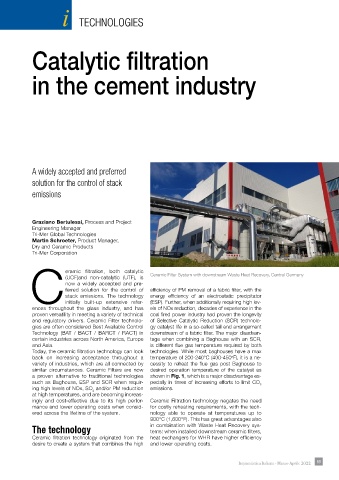
                        (UCF)and non-catalytic (UTF), is   Ceramic Filter System with downstream Waste Heat Recovery, Central Germany
                        now a widely accepted and pre-
                        ferred solution for the control of   efficiency of PM removal of a fabric filter, with the
                        stack emissions. The technology   energy  efficiency  of an  electrostatic  precipitator
            C initially built-up extensive refer-     (ESP). Further, when additionally requiring high lev-
            ences throughout the glass industry, and has   els of NOx reduction, decades of experience in the
            proven versatility in meeting a variety of technical   coal fired power industry had proven the longevity
            and regulatory drivers. Ceramic Filter technolo-  of Selective Catalytic Reduction (SCR) technolo-
            gies are often considered Best Available Control   gy catalyst life in a so-called tail end arrangement
            Technology (BAT / BACT / BARCT / RACT) in   downstream of a fabric filter. The major disadvan-
            certain industries across North America, Europe   tage when combining a Baghouse with an SCR,
            and Asia.                                 is different flue gas temperature required by both
            Today, the ceramic filtration technology can look   technologies. While most baghouses have a max
            back on increasing acceptance throughout a   temperature of 200-240°C (400-450 F), it is a ne-
                                                                                  o
            variety of industries, which are all connected by   cessity to reheat the flue gas post Baghouse to
            similar circumstances. Ceramic Filters are now   desired operation temperature of the catalyst as
            a proven alternative to traditional technologies   shown in Fig. 1, which is a major disadvantage es-
            such as Baghouse, ESP and SCR when requir-  pecially in times of increasing efforts to limit CO
                                                                                            2
            ing high levels of NOx, SO  and/or PM reduction   emissions.
                                  2
            at high temperatures, and are becoming increas-
            ingly  and  cost-effective  due  to its high perfor-  Ceramic Filtration technology negates the need
            mance and lower operating costs when consid-  for costly reheating requirements, with the tech-
            ered across the lifetime of the system.   nology able to operate at temperatures up to
                                                      900°C (1,600°F). This has great advantages also
            The technology                            in combination with Waste Heat Recovery sys-
                                                      tems: when installed downstream ceramic filters,
            Ceramic filtration technology originated from the   heat exchangers for WHR have higher efficiency
            desire to create a system that combines the high   and lower operating costs.


                                                                                     Impiantistica Italiana - Marzo-Aprile 2022  69

