


Page 30 - Industrial Plants
P. 30
reaches 40 m of water depth. It was, therefore, preferred   This correlates with a lack of disseminated iron
                             to use the geoelectric resistivity method with tomographic   usually characteristic of the lowermost and topmost
                             processing (ERT).  In addition, considering the need  to   Beds. This lack of disseminated iron in turn correlates
                             maintain a high resolution capacity, as well as the   with an increase in the amount of clay within the
                             considerable depths involved in the outermost area, it   Member at this locality. It is atypical concentration of
                             was decided to lay the electrode cables for the execution   clay minerals that may well be responsible for the
                             of the measurements directly on the seabed. This   formation of the preferential diagenesis within this
                             entailed the need to use specifically made cable, with an   member as a whole at Delimara. Neomorphism of
                             extension of 50 m with respect to the position of the first   the lime mud is particularly  prominent in the
                             electrode lying on the bottom.            carbonate zones and essentially absent from the
                                                                       marly horizons. As a result, the carbonate zones are
                                                                       more lithified than the marly horizons.
                             Geological and geomorphological           The division between the Upper and the Middle
                             features                                  Globigerina Limestone is marked by the presence of
                                                                       a conglomerate phosphate-rich bed named C2
                             The site  has been investigated along a line   (Pedley 1975) in which most of the pebble material
                             approximately WNW to ESE of about 1200 m. The   is extensively perforated or pitted and infilled with
                             elevation above mean sea level varies from about 30   glauconite.
                             metres at the western and decreasing to about   The Middle Globigerina Limestone is classified as a
                             -42.0 m, below mean sea level, at the eastern   clayey biomicrite rich in planktonic foraminifera. This
                             shoreline.                                member is generally characterised by compact, light
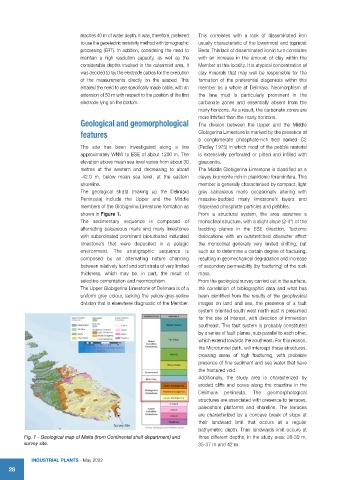
                             The geological strata (making up the Delimara   grey  calcareous  marls  occasionally  altering  with
                             Peninsula) include the Upper and the Middle   massive-bedded marly limestone’s layers and
                             members of the Globigerina Limestone formation as   dispersed phosphate particles and pebbles.
                             shown in Figure 1.                        From a structural system, the area assumes a
                             The sedimentary sequence is composed of   monoclinal structure, with a slight slope (2-4°) of the
                             alternating calcareous marls and marly limestones   bedding planes in the ESE direction. Tectonic
                             with subordinated prominent bioturbated indurated   dislocations  with  an  outstretched  character  affect
                             limestone’s that were deposited in a pelagic   the  monoclinal  generally very  limited  shifting, but
                             environment.  The  stratigraphic  sequence  is   such as to determine a certain degree of fracturing,
                             composed by an alternating nature chancing   resulting in geomechanical degradation and increase
                             between relatively hard and soft strata of very limited   of secondary permeability (by fracturing) of the rock
                             thickness, which may be, in part, the result of   mass.
                             selective cementation and neomorphism.    From the geological survey carried out in the surface,
                             The Upper Globigerina Limestone of Delimara is of a   the correlation of bibliographic data and what has
                             uniform grey colour, lacking the yellow-grey-yellow   been identified from the results of the geophysical
                             division that is elsewhere diagnostic of the Member.   images on land and sea, the presence of a fault
                                                                       system oriented south-west north-east is presumed
                                                                       for the site of interest, with direction of immersion
                                                                       southeast. This fault system is probably constituted
                                                                       by a series of fault planes, sub-parallel to each other,
                                                                       which extend towards the southeast. For this reason,
                                                                       the Microtunnel path, will intercept these structures,
                                                                       crossing areas  of  high fracturing, with  probable
                                                                       presence of fine sediment and sea water that have
                                                                       the fractured void.
                                                                       Additionally, the study area is characterized by
                                                                       eroded  cliffs and coves  along  the coastline in the
                                                                       Delimara  peninsula.  The  geomorphological
                                                                       structures are associated with presence to terraces,
                                                                       paleoshore platforms and shoreline. The terraces
                                                                       are characterized by a concave break of slope at
                                                                       their landward limit  that occurs  at a  regular
                                                                       bathymetric depth. Their landwards limit occurs at
          Fig. 1 - Geological map of Malta (from Continental shelf department) and   three different depths, in the study area: 28-30 m,
          survey site.                                                 35-37 m and 42 m.


            IndustrIal Plants - May 2022
    28

