


Page 74 - Industrial Plants
P. 74
equipment so that any external means aimed at limiting   comes from the axial fans, whose noise can be
                             noise propagation, such barriers or other obstacles,   significantly higher than the aggregate noise from other
                             may be quite expensive.                   sources.
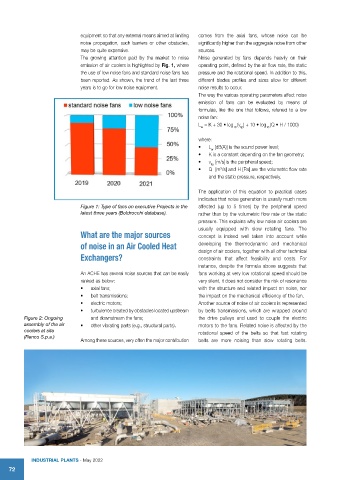
                             The growing attention paid by the market to noise   Noise generated by fans depends heavily on their
                             emission of air coolers is highlighted by Fig. 1, where   operating point, defined by the air flow rate, the static
                             the use of low noise fans and standard noise fans has   pressure and the rotational speed. In addition to this,
                             been reported. As shown, the trend of the last three   different blades profiles and sizes allow for different
                             years is to go for low noise equipment.   noise results to occur.
                                                                       The way the various operating parameters affect noise
                                                                       emission of fans can be evaluated by means of
                                                                       formulae, like the one that follows, referred to a low
                                                                       noise fan:
                                                                       L  = K + 30 • log (v ) + 10 • log (Q • H / 1000)
                                                                        w          10   tip    10
                                                                       where:
                                                                       •   L  [dB(A)] is the sound power level;
                                                                           w
                                                                       •   K is a constant depending on the fan geometry;
                                                                       •   v [m/s] is the peripheral speed;
                                                                           tip
                                                                       •   Q  [m /s] and H [Pa] are the volumetric flow rate
                                                                              3
                                                                          and the static pressure, respectively.
                                                                       The application of this equation to practical cases
                                                                       indicates that noise generation is usually much more
                             Figure 1: Type of fans on executive Projects in the   affected (up to 5 times) by the peripheral speed
                             latest three years (Boldrocchi database).  rather than by the volumetric flow rate or the static
                                                                       pressure. This explains why low noise air coolers are
                                                                       usually  equipped  with  slow  rotating  fans.  The
                             What are the major sources                concept is indeed well taken into account while

                             of noise in an Air Cooled Heat            developing the thermodynamic and mechanical
                                                                       design of air coolers, together with all other technical
                             Exchangers?                               constraints that affect feasibility and costs. For

                                                                       instance, despite the formula above suggests that
                             An ACHE has several noise sources that can be easily   fans working at very low rotational speed should be
                             ranked as below:                          very silent, it does not consider the risk of resonance
                             •   axial fans;                           with the structure and related impact on noise, nor
                             •   belt transmissions;                   the impact on the mechanical efficiency of the fan.
                             •   electric motors;                      Another source of noise of air coolers is represented
                             •   turbulence created by obstacles located upstream   by belts transmissions, which are wrapped around
          Figure 2: Ongoing      and downstream the fans;              the drive pulleys and used to couple the electric
          assembly of the air   •   other vibrating parts (e.g., structural parts).  motors to the fans. Related noise is affected by the
          coolers at site                                              rotational speed of the belts so that fast rotating
          (Renco S.p.a.)
                             Among these sources, very often the major contribution   belts are more noising than slow rotating belts.


            IndustrIal Plants - May 2022
    72

