


Page 76 - Industrial Plants
P. 76
applied to a specific project. What is important to note
                             is that the various expediencies are not always   “Our Companies started the
                             independent of each other, and related effectiveness   discussions over the Preliminary
                             can increase significantly in case of joint application   Specifications for the three Air Cooled
                             with other expediencies. For instance, the use of low   Heat Exchangers destined
                             noise fans is more effective at reduced air flow rates,   for a gas compression station
                             which must be compensated by an increased heat     in Denmark in 2019
                             exchange surface.
                                                                       Although the operating pressure of the process fluid
                             Case study:                               (i.e., natural gas) was relatively high, namely 113 bar-g
                             Gas compression station                   at 92°C, the main concerns were related to the
                                                                       maximum allowable noise level only, which was
                             in 2019, we started the discussions over the Preliminary   tremendously low. The plant was planned to be located
                             Specifications for the three Air Cooled Heat Exchangers   in a rural area, at a distance of about 500 m from some
                             destined for a gas compression station in Denmark. At   residential buildings and, according to the EIA permit,
                             that time, Renco was preparing their Bid to win the   the  maximum  noise  emission  at  these  critical  points
                             Project and asked Boldrocchi to co-operate and   should have been limited to 35dB(A). Based on
                             support in order to develop a solution suitable for the   preliminary estimations, the Air Cooled Heat Exchangers
                             specific needs.                           had been identified as the major noise sources of the
                                                                       Plant, whereas the other machinery were not critical, as
                                                                       they were considered to be installed inside insulated
                                                                       buildings.

                                                                       The maximum allowable Noise Power Level of each air
                                                                       cooler running at full load was limited to 87 dB(A),
                                                                       based on the noise spreading simulations and the
                                                                       resulting expected noise level at the residential
                                                                       buildings.
                                                                       The cooperation between Renco and Boldrocchi
                                                                       allowed the starting of the design process without
                                                                       considering any footprint constraints, nor requirements
                                                                       related to the type of fans, motors, and other noise
                                                                       affecting parts. This degree of freedom allowed for the
                                                                       identification of the optimal technical and cost-effective
                                                                       solution. Then, some adjustments have been applied
                                                                       to the proposed design, to better integrate the air
                                                                       coolers within the overall plant.


                                                                       Noise driven design of Air Cooled
                                                                       Heat Exchangers


                                                                       Coming back to the origins, the noise-driven design
                                                                       started from the identification of a base solution,
                                                                       compliant with the process needs (i.e., cooling of
                                                                       the given natural gas stream), but exceeding the
                                                                       noise requirement. The first two adjustments applied
                                                                       to the design have been the adoption of bell-shaped
                                                                       fan rings and the reduction of the fans rotational
                                                                       speed, as shown in the left side of Figure 4.
                                                                       However, this allowed only for a slight reduction of
                                                                       noise to be obtained, which was furtherly improved
                                                                       when low noise type fans were considered in place
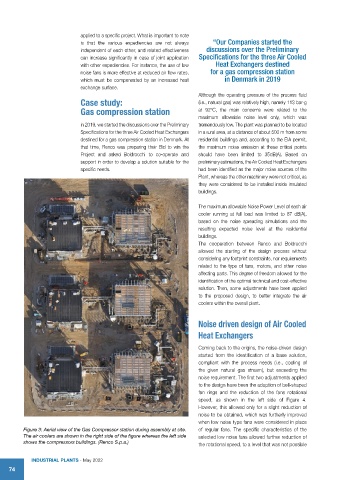
         Figure 3: Aerial view of the Gas Compressor station during assembly at site.   of regular fans. The specific characteristics of the
         The air coolers are shown in the right side of the figure whereas the left side   selected low noise fans allowed further reduction of
         shows the compressors buildings. (Renco S.p.a.)               the rotational speed, to a level that was not possible


            IndustrIal Plants - May 2022
    74

