


Page 75 - Industrial Plants
P. 75
Noise can then vary according to the type of belts:
            synchronous belts (i.e. toothed belts) are less silent  How to limit noise emission
            than V-type belts because of the continuous impacts   of Air Cooled Heat Exchangers
            of the belts teeth to the pulleys teeth, and because
            of the very fast evacuation of air, which occur   Many factors can be applied to design low noise air
            continuously during operation, when the belts teeth   coolers. Some of them affect the capability of the
            match the pulleys teeth.                  equipment to transfer heat to the ambient air (e.g.,
            Noise emitted by electric motors is due to different   reduced ambient air flow through the heat exchanger)
            components/mechanisms  like  mechanical  noise   and shall therefore be balanced by oversizing the heat
            related to bearings, electromagnetic noise, and   exchange  surface, with  impact  on CAPEX. Other
            noise due to the cooling fans. In case of ultra low   expediencies are instead related to detailed design and
            noise applications, electric motors noise can be of   applied based upon experience or specific calculations,
            the same magnitude of that of the fans, requiring   when convenient. Some examples are the attention to
            particular attention to their selection. A further   the correct positioning of the safety nets, the use of
            aspect taken into account when designing air   vibration isolators, and the adoption of bell-shaped
            coolers is that motors driven by variable frequency   fans rings.
            drives (i.e., inverters) emit more noise than motors   Not only that, the collaboration between the
            directly connected on-line. This is due to  the   manufacturer and the EPC / plant operator may allow
            harmonics resulting from the variable frequency   creative solutions to be identified and implemented, not
            drives.                                   strictly related to the design of the equipment but to the
                                                      way it is used and controlled by the plant control
            While designing air coolers, consideration is given to   system as well. For instance, a possibility could be to
            the presence of any obstacles upstream and   design the air cooler for fulfilling the noise requirements
            downstream from the fans like the safety nets aimed   set  for  daytime,  and  to  turn  off  some  fans  during
            at maintenance personnel avoiding getting into   nighttime, when the noise limitations are usually more
            contact with the rotating parts. Provisions like these   stringent. Depending on the application, this might be
            affect the noise performance of air coolers because   convenient as the capability of air coolers to dissipate
            of both the additional static pressure required by the   heat increases, the lower the ambient temperature.
            fans,  and  because  of  the  turbulence  therein
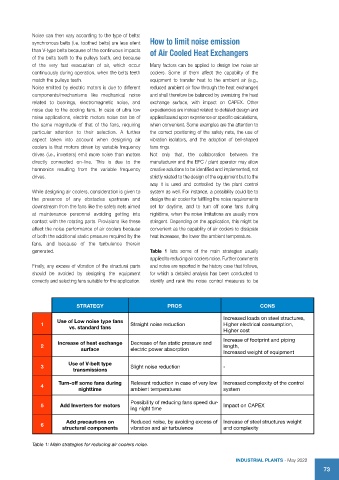
            generated.                                Table 1 lists some of the main strategies usually
                                                      applied to reducing air coolers noise. Further comments
            Finally, any excess of vibration of the structural parts   and notes are reported in the history case that follows,
            should be avoided by designing the equipment   for which a detailed analysis has been conducted to
            correctly and selecting fans suitable for the application.  identify and rank the noise control measures to be


                            STRATEGY                        PROS                            CONS
                                                                               Increased loads on steel structures,
                     Use of Low noise type fans
               1                               Straight noise reduction        Higher electrical consumption,
                         vs. standard fans
                                                                               Higher cost
                                                                               Increase of footprint and piping
                     Increase of heat exchange   Decrease of fan static pressure and
               2                                                               length,
                             surface           electric power absorption
                                                                               Increased weight of equipment
                         Use of V-belt type
               3                               Slight noise reduction          -
                           transmissions

                      Turn-off some fans during   Relevant reduction in case of very low  Increased complexity of the control
               4
                             nighttime         ambient temperatures            system
                                               Possibility of reducing fans speed dur-
               5      Add Inverters for motors                                 Impact on CAPEX
                                               ing night time
                        Add precautions on     Reduced noise, by avoiding excess of  Increase of steel structures weight
               6
                       structural components   vibration and air turbulence    and complexity

            Table 1: Main strategies for reducing air coolers noise.

                                                                                    IndustrIal Plants - May 2022
                                                                                                                   73

