


Page 21 - 77
P. 21
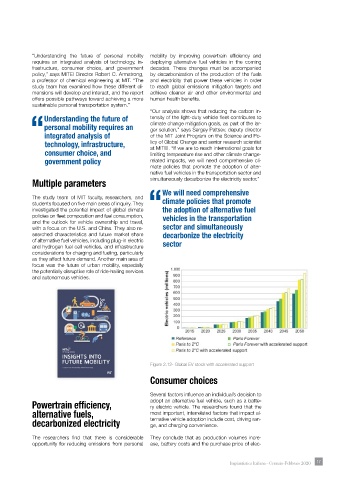
“Understanding the future of personal mobility   mobility  by improving  powertrain  effi ciency  and
            requires an integrated analysis  of technology, in-  deploying alternative fuel vehicles in the coming
            frastructure, consumer choice, and government   decades. These changes must be accompanied
            policy,” says MITEI Director Robert C. Armstrong,   by decarbonization of the production of the fuels
            a professor of chemical engineering at MIT. “The   and electricity that power these vehicles in order
            study team has examined how these different di-  to reach global emissions mitigation targets  and
            mensions will develop and interact, and the report   achieve cleaner air and other environmental and
            offers possible pathways toward achieving a more   human health benefi ts.
            sustainable personal transportation system.”
                                                      “Our analysis shows that reducing the carbon in-
                 Understanding the future of          tensity of the light-duty vehicle fl eet contributes to
                 personal mobility requires an        climate change mitigation goals, as part of the lar-
                                                      ger solution,” says Sergey Paltsev, deputy director
            “integrated analysis of                   of the MIT Joint Program on the Science and Po-
                 technology, infrastructure,          licy of Global Change and senior research scientist
                                                      at MITEI. “If we are to reach international goals for
                 consumer choice, and                 limiting temperature rise and other climate change-
                 government policy                    related impacts, we will need comprehensive cli-
                                                      mate policies that promote the adoption of alter-
                                                      native fuel vehicles in the transportation sector and
            Multiple parameters                       simultaneously decarbonize the electricity sector.”
                                                          We will need comprehensive
            The study team of MIT faculty, researchers, and
            students focused on fi ve main areas of inquiry. They   climate policies that promote
            investigated the potential impact of global climate “the adoption of alternative fuel
            policies on fl eet composition and fuel consumption,   vehicles in the transportation
            and the outlook for vehicle ownership and travel,
            with a focus on the U.S. and China. They also re-  sector and simultaneously
            searched characteristics and future market share   decarbonize the electricity
            of alternative fuel vehicles, including plug-in electric
            and hydrogen fuel cell vehicles, and infrastructure   sector
            considerations for charging and fueling, particularly
            as they affect future demand. Another main area of
            focus was the future of urban mobility, especially
            the potentially disruptive role of ride-hailing services
            and autonomous vehicles.


                                                      Figure 2.12- Global EV stock with accelerated support

                                                      Consumer choices


                                                      Several factors infl uence an individual’s decision to
            Powertrain effi ciency,                    adopt an alternative fuel vehicle, such as a batte-
                                                      ry electric vehicle. The researchers found that the
            alternative fuels,                        most important, interrelated factors that impact al-
            decarbonized electricity                  ternative vehicle adoption include cost, driving ran-
                                                      ge, and charging convenience.

            The  researchers  fi nd  that  there  is  considerable   They conclude that as production volumes incre-
            opportunity for reducing emissions from personal   ase, battery costs and the purchase price of elec-


                                                                                  Impiantistica Italiana - Gennaio-Febbraio 2020  17

