


Page 34 - 77
P. 34
technology


                                expanded gas to provide the main refrigera-
                                tion duty for natural gas cooling; the natural   According to the above-mentioned characteristics,
                                recirculation is ensured by a gas compressor   this  liquefaction  technology  allows  the following
                                that has also the function to maintain the LNG   advantages:
                                liquefaction exchanger at the optimal pressure   •   Compact arrangement due to a limited num-
                                for an effective liquefaction            ber of equipment
                            •   one closed nitrogen turbo-expander cycle for   •   Versatile process for a wide range of feed gas
                                natural gas cold end refrigeration; the refrige-  composition
                                rant  recirculation  is  performed  by  a  nitrogen   •   Intrinsic safety as liquid hydrocarbon inventori-
                                compressor                               es are minimized, and cryogenic spillages are
                                                                         limited
                            The compression train driver is selected according   •   Low depressurization flowrates
                            to the liquefaction capacity required and the overall   •   Simplified operation as the refrigerant compo-
                            plant energy configuration.                  sition adjustment is not required
                                                                      •   Fast and smooth transient management as no
                            NGL is formed at the exhaust of the warm gas ex-  sudden temperature variation will occur due to
                            pander and is separated from the residue gas in   liquid boiling
                            a dedicated drum, equipped with a reboiler that   •   High  efficiency  due  to  an  optimized  thermal
                            ensures that methane is fully rejected in the resi-  balancing of the liquefaction cold box
                            due gas. The separation is performed at a redu-  •   High availability, as the plant can continue to
                            ced pressure; thus it is very selective and a limited   produce (at reduced capacity) even if an ex-
                            amount of methane is being condensed together   pander is shut down.
                            with the NGL. According to the gas composition
                            and the project needs, the drum can be replaced   According to the feed gas quality, if the content of
                            with a contactor to enhance the NGL extraction.  C + is already acceptable for the cryogenic facili-
                                                                       5
                                                                      ties, an NGL extraction system is not required. To
                            The main equipment of the liquefaction process   scrub traces of aromatics that can affect the proper
                            is  the  Cold  Box,  that  assembles  plate  fin  heat   operation of the liquefaction unit, additional replace
                            exchangers, a drum, connecting piping and mani-  with “adsorbent bed” may be integrated into the
                            folds and valves for a maximum compactness. This   gas dehydration unit.
                            also allows to confine inside the cold box most of
                            the cryogenic liquids. The optimization of the hot   For richer pipeline gases with an excessive heavies
                            and cold composite curves profile along the whole   content, an NGL extraction drum will be included
                            temperature range of the cold box allows the maxi-  and the extracted NGL is used as fuel or exported.
                            mization of the energy efficiency.  The low-pressure   The opportunity of LPG reinjection is to be evalua-
                            end flash drum is included in the cold box. The   ted according to the Methane number specifica-
                            flashed gas is partially warmed up in the Cold Box   tion, that may need to be adjusted for bunkering
                            to utilize the thermal duty of this gas stream for re-  and gas engine applications.
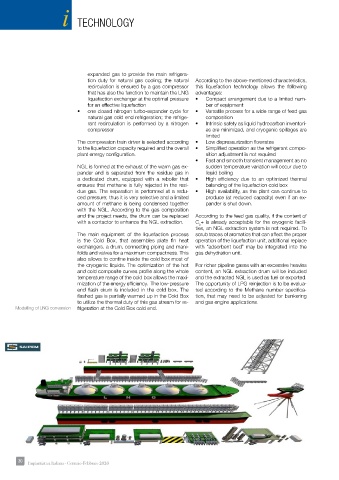
      Modelling of LNG conversion  frigeration at the Cold Box cold end.


       30 30  Impiantistica Italiana - Gennaio-Febbraio 2020

