


Page 33 - 77
P. 33
According to the European directive of the Trans-  DRY
            European Transport Network, an average distance   GAS
            of 400 km should be maintained between refuelling
            stations. While this value is widely met in some are-
            as, in others like south of Italy or Greece, there is a
            lack of refuelling points.                                           Gas Compressor   N2 Compressor


            LNG for off-grid users
            Off-grid users represent those small industries or
            other type of consumers for which gas is supplied   NGL
            by other means  than the grid,  typically by truck
            (LNG). Additional island users are some commu-                              EFG
            nities in the mountains or in other remote locations
            where gas is received in liquefi ed form and is then
            regassifi ed and injected in a smaller local pipeli-
            ne network for domestic and industrial uses. The
            trucks bringing LNG to off-grid users may need to                        LNG
            travel a very long distance in those countries where
            gas is not distributed in its liquefi ed form as a fuel                                    1
            yet. Distribution costs can be signifi cant and may   Liquefl  ex ™ process scheme
            discourage the use of LNG despite its cleaner envi-
            ronmental footprint than the existing alternative so-  As the pipeline gas is already treated in complian-
            lutions. Therefore, the availability of new distribution   ce with market specifi cations, the pre-treatment
            points would encourage the development of LNG   function of the LNG plant is limited to the further
            also among off-grid users.                reduction of contaminants to cope with the cryo-
                                                      genic liquefaction process (i.e. CO  and water re-
                                                                                 2
                                                      duction to ppm). The dehydration unit is designed
            Saipem solution                           including two vessels working in parallel mode (one
                                                      in adsorption, one in regeneration). The mercury re-
            for small scale LNG plants                moval beds are installed in series to the molecular
                                                      sieves on the same vessels. The dry gas from mo-
            The proposed small-scale LNG facilities have been   lecular sieve is routed to the liquefaction unit.
            designed for 250,000 TPA LNG production, based
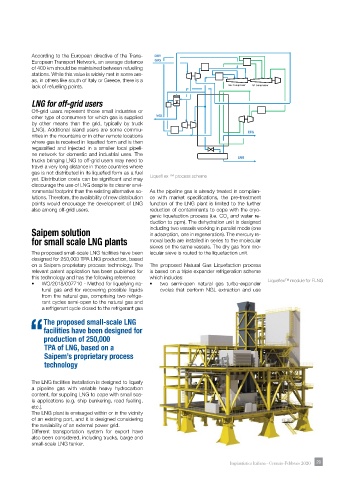
            on a Saipem proprietary process technology. The   The proposed Natural Gas Liquefaction process
            relevant patent application has been published for   is based on a triple expander refrigeration scheme
            this technology and has the following reference:  which includes:
            •   WO/2018/007710 - Method for liquefying na-  •   two semi-open natural gas turbo-expander   Liquefl ex™ module for FLNG
                tural gas and for recovering possible liquids   cycles  that  perform  NGL  extraction  and  use
                from the natural gas, comprising two refrige-
                rant cycles semi-open to the natural gas and
                a refrigerant cycle closed to the refrigerant gas

                The proposed small-scale LNG
                facilities have been designed for
           “production of 250,000
                 TPA of LNG, based on a
                 Saipem’s proprietary process
                 technology


            The LNG facilities installation is designed to liquefy
            a  pipeline  gas  with  variable  heavy  hydrocarbon
            content, for suppling LNG to cope with small sca-
            le applications (e.g. ship bunkering, road fuelling,
            etc.).
            The LNG plant is envisaged within or in the vicinity
            of an existing port, and it is designed considering
            the availability of an external power grid.
            Different transportation system for export have
            also been considered, including trucks, barge and
            small-scale LNG tanker.


                                                                                  Impiantistica Italiana - Gennaio-Febbraio 2020  29 29

