


Page 23 - Impiantistica Industriale
P. 23
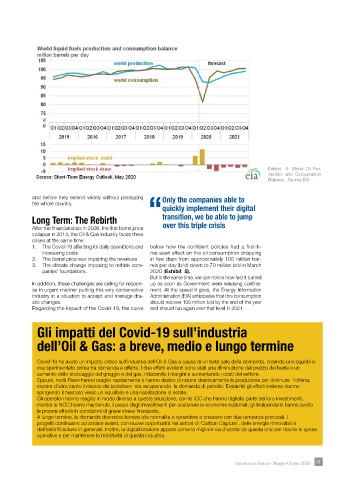
Exhibit  5: World Oil Pro-
                                                                                               duction and Consumption
                                                                                               Balance - Source EIA

            and before they extend widely without paralyzing   Only the companies able to
            the whole country.
                                                          quickly implement their digital
            Long Term: The Rebirth                   “transition, we be able to jump
            After the fi nancial crisis in 2008, the fi rst barrel price   over this triple crisis
            collapse in 2014, the Oil & Gas industry faces three
            crises at the same time:
            1.  The Covid-19 affecting its daily operations and   below  how  the  confi dent  policies  had  a  fi rst-ti-
                increasing costs                      me-seen effect on the oil consumption dropping
            2.  The barrel price war impairing the revenues  in few days from approximately 100 million bar-
            3.  The climate change imposing to rethink com-  rels per day (b/d) down to 70 million b/d in March
                panies’ foundations.                  2020 (Exhibit  5).
                                                      But in the same time, we can notice how fast it turned
            In addition, these challenges are calling for respon-  up as soon as Government were releasing confi ne-
            se in urgent manner putting this very conservative   ment. At the speed it goes, the Energy Information
            industry in a situation to accept and manage dra-  Administration (EIA) anticipates that this consumption
            stic changes.                             should recover 100 million b/d by the end of the year
            Regarding the impact of the Covid-19, the curve   and should run again over that level in 2021.


              Gli impatti del Covid-19 sull’industria

              dell’Oil & Gas: a breve, medio e lungo termine


              Covid-19 ha avuto un impatto critico sull’industria dell’Oil & Gas a causa di un forte calo della domanda, creando uno squilibrio
              mai sperimentato prima tra domanda e offerta. I due effetti evidenti sono stati una diminuzione del prezzo del barile e un
              aumento dello stoccaggio del greggio e del gas, riducendo i margini e aumentando i costi del settore.
              Eppure, molti Paesi hanno reagito rapidamente e hanno deciso di ridurre drasticamente la produzione per diminuire  l’offerta,
              mentre d’altro canto il rilascio dal lockdown  sta recuperando  la domanda di petrolio. Entrambi gli effetti insieme stanno
              spingendo il mercato verso un equilibrio e una riabilitazione in estate.
              Gli operatori hanno reagito in modo diverso a questa situazione, con le IOC che hanno tagliato parte dei loro investimenti,
              mentre le NOC hanno mantenuto il passo degli investimenti per sostenere le economie nazionali; gli Indipendenti hanno svolto
              le proprie attività in condizioni di grave stress fi nanziario.
              A lungo termine, la domanda dovrebbe tornare alla normalità e riprendere a crescere con due tendenze principali. I
              progetti continuano ad andare avanti, con nuove opportunità nei settori di ‘Carbon Capture’, delle energie rinnovabili e
              dell’elettrifi cazione in generale. Inoltre, la digitalizzazione appare come la migliore via d’uscita da questa crisi per ridurre le spese
              operative e per mantenere la redditività di questa industria.


                                                                                   Impiantistica Italiana - Maggio-Giugno 2020  21 21

