


Page 30 - Impiantistica Industriale
P. 30
TECNOLOGIE


                                                                      Modalità di installazione
                                                                      del tappo STP
                                                                      a filettatura conica

                                                                      Per ottenere il risultato atteso, è opportuno segui-
                                                                      re le modalità di installazione del tappo appresso
                                                                      elencate:
                                                                      •   pulizia accurata del foro;
                                                                      •   verifica dimensionale del diametro interno;
                                                                      •   verifica della compatibilità del tappo previsto;
                                                                      •   realizzazione eventuale foratura cilindrica;
                                                                      •   realizzazione maschiatura conica NPT specia-
                                                                         le;
                                                                      •   lubrificazione con sigillante idoneo;
                                                                      •   installazione del tappo;
                                                                      •   serraggio del tappo alla coppia di serraggio
                                                                         prestabilita (Fig. 9).


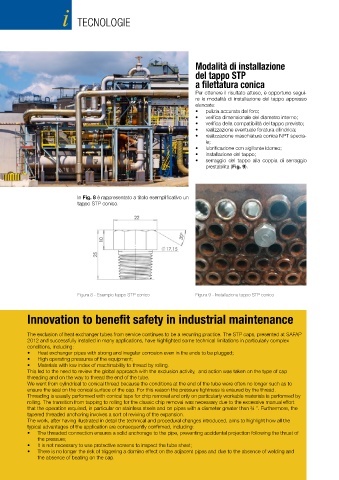
                            In Fig. 8 è rappresentato a titolo esemplificativo un
                            tappo STP conico.


                            Figura 8 - Esempio tappo STP conico       Figura 9 - Installazione tappo STP conico


           Innovation to benefit safety in industrial maintenance


           The exclusion of heat exchanger tubes from service continues to be a recurring practice. The STP caps, presented at SAFAP
           2012 and successfully installed in many applications, have highlighted some technical limitations in particularly complex
           conditions, including:
           •   Heat exchanger pipes with strong and irregular corrosion even in the ends to be plugged;
           •   High operating pressures of the equipment;
           •   Materials with low index of machinability to thread by rolling.
           This led to the need to review the global approach with the exclusion activity,  and action was taken on the type of cap
           threading and on the way to thread the end of the tube.
           We went from cylindrical to conical thread because the conditions at the end of the tube were often no longer such as to
           ensure the seal on the conical surface of the cap. For this reason the pressure tightness is ensured by the thread.
           Threading is usually performed with conical taps for chip removal and only on particularly workable materials is performed by
           rolling. The transition from tapping to rolling for the classic chip removal was necessary due to the excessive manual effort
           that the operation required, in particular on stainless steels and on pipes with a diameter greater than ¾ “. Furthermore, the
           tapered threaded anchoring involves a sort of reviving of the expansion.
           The work, after having illustrated in detail the technical and procedural changes introduced, aims to highlight how all the
           typical advantages of the application are consequently confirmed, including:
           •   The threaded connection ensures a solid anchorage to the pipe, preventing accidental projection following the thrust of
              the pressure;
           •   It is not necessary to use protective screens to inspect the tube sheet;
           •   There is no longer the risk of triggering a domino effect on the adjacent pipes and due to the absence of welding and
              the absence of beating on the cap.
       26 26  Impiantistica Italiana - Settembre-Ottobre 2021

