


Page 46 - Impiantistica industriale
P. 46
ENGINEERING


                            This effort led to minimise possible risks of a turna-  the installation methods of the project.
                            round time increase during the execution.  Constructability and schedule assessment drove
                            To support the planning, the project team carried   a number of decisions that influenced the execu-
                            out detailed constructability studies that became a   tion of the entire project, from engineering phase
                            fundamental element for a robust project execution   up to construction subcontracts scope throughout
                            and schedule baseline reference.          vendor equipment fabrication and pre-assembly
                                                                      extent.
                            Constructability studies - 3D             Upfront constructability decisions enabled the
                                                                      team to address the project requirements at the
                            simulations - Construction                right time, avoiding last-minute turnaround plan
                            Execution Plan                            reshuffling.
                                                                         FCC regenerator replacement in a single piece
                                                                      •
                            Physical and time project constraints required the   and new isolation valve/flue gas line modula-
                            identification well in advance of the constructability   risation
                            main aspects:                                The periodic 4-5 year FCC maintenance con-
                            •   Refinery accessibility;                  sisting of the traditional replacement of the
                            •   Limited laydown, prefabrication, and access   FCC regenerator head with cyclones is already
                                areas inside the refinery;               a well-established work process for the refine-
                            •   Material and personnel logistic;         ry, including the lifting plan using a 1,350 tons
                            •   Construction operation interferences with exi-  crane. However, during 2019 the FCC regene-
                                sting infrastructures;                   rator shell and bottom cone were approaching
                            •   Heavy liftings studies, including cranes selec-  the end-of-life status.
                                tion and booking plan.                   Due to this, the ‘Turnaround 2020 Project’
                            The ‘engineering driven by construction’ concept   scope included the complete FCC regenera-
                            was important in the design solutions to support   tor replacement. The execution of this activity
                                                                         became substantially different with respect to
                                                                         the regenerator and usual head and cyclones
                                                                         replacement.
                                                                         The project objective to minimise the turna-
                                                                         round activities guided the decision to maximi-
                                                                         se the equipment overall fabrication during the
                                                                         pre-turnaround phase and lift the FCC regene-
                                                                         rator in a single piece during the turnaround.
                                                                         This significantly increased the weight to be
                                                                         lifted. The overall weight of the FCC regene-
                                                                         rator fully preassembled including the internal
                                                                         refractory  liner  became  550  tons.  The  high
                                                                         regenerator dead weight required a specific
                                                                         equipment mechanical calculation to verify
                                                                         the resistance to its own load during the lifting
                                                                         operations.
                                                                         Space refinery constraints did not allow place-
                                                                         ment of the crane close to the regenerators fi-
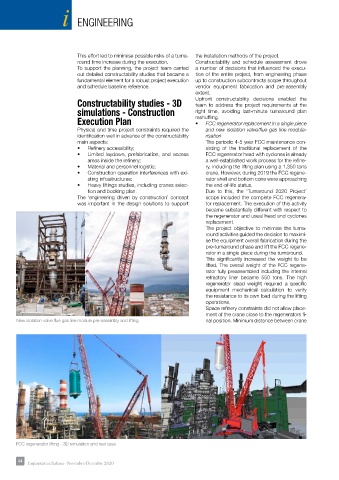
       New isolation valve flue gas line module pre-assembly and lifting  nal position. Minimum distance between crane


       FCC regenerator lifting - 3D simulation and real case

       44 44  Impiantistica Italiana - Novembre-Dicembre 2020

