


Page 29 - Impiantistica Italiana
P. 29
Workforce Demand (WFD)

            The Workforce Demand evaluation (WFD) is a
            prediction of the evolution of the required workforce,
            exploiting a “What-If” scenario to get insight into the
            business policies’ infl uence on the future personnel
            structure. Thus, the main goal of the WFD study is to
            estimate present and future workforce requirements
            to  execute  a  project  [3].  As  mentioned  by  Huang
            [4], the total demand must be in form of “projects”
            skill requirements [man-hours per skill or job-role].
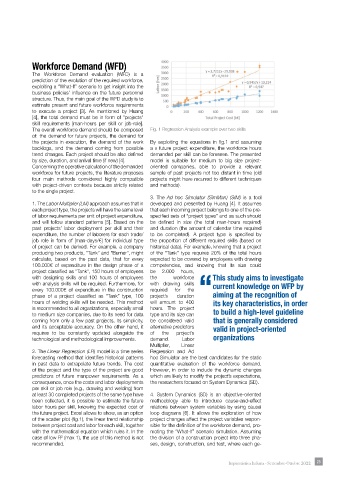
            The overall workforce demand should be composed   Fig. 1 Regression Analysis example over two skills
            of: the demand for future projects, the demand for
            the projects in execution, the demand of the work   By  exploiting  the  equations  in  fi g.1 and  assuming
            backlogs, and the demand coming from possible   a x future project expenditure, the workforce hours
            trend changes. Each project should be also defi ned   demanded per skill can be foreseen. The presented
            by size, duration, and arrival time (if new) [4].   model is suitable for  medium to big size project-
            Concerning the operative calculation of the demanded   oriented companies, able to provide a relevant
            workforce for future projects, the literature proposes   sample of past projects not too distant in time (old
            four main methods considered highly compatible   projects might have recurred to different techniques
            with project-driven contexts because strictly related   and methods).
            to the single project.
                                                      3.  The  Ad hoc Simulator  (SimMan)  (SIM) is a  tool
            1. The Labor Multiplier (LM) approach assumes that in   developed and presented by Huang [4]. It assumes
            each project type, the projects will have the same level   that each incoming project belongs to one of the pre-
            of labor requirements per unit of project expenditure,   specifi ed sets of “project types” and as such should
            and will follow standard patterns [5]. Based on the   be defi ned in size (the total man-hours required)
            past projects’ labor deployment per skill and their   and duration (the amount of calendar time required
            expenditure, the number of laborers for each trade/  to be completed). A project type is specifi ed by
            job role in form of [man-days/€] for individual type   the proportion of different required skills (based on
            of project can be derived. For example, a company   historical data). For example, knowing that a project
            producing two products, “Tank” and “Burner”, might   of the “Tank” type requires 20% of the total hours
            calculate, based on the past data, that for every   expected to be covered by employees with drawing
            100.000€ of expenditure in the design phase of a   competencies, and knowing that its size could
            project classifi ed as “Tank”, 150 hours of employees   be  2.000  hours,
            with designing skills and 100 hours of employees   the  workforce  This study aims to investigate
            with analysis skills will be required. Furthermore, for   with  drawing skills   current knowledge on WFP by
            every 100.000€ of expenditure in the construction   required  for  the
                                                               duration
            phase  of  a  project  classifi ed  as  “Tank”  type,  100   project’s “aiming at the recognition of
            hours of welding skills will be needed. This method   will amount to 400   its key characteristics, in order
            is recommended to all organizations, especially small   hours. The project
            to medium size companies, due to its need for data   type and its size can   to build a high-level guideline
            coming from only a few past projects, its simplicity,   be considered valid   that is generally considered
            and its acceptable accuracy. On the other hand, it   alternative predictors   valid in project-oriented
            requires to be constantly updated alongside the   of  the  project’s
            technological and methodological improvements.   demand.  Labor  organizations
                                                      Multiplier,  Linear
            2. The Linear Regression (LR) model is a time series   Regression and Ad
            forecasting method that identifi es historical patterns   hoc Simulator are the best candidates for the static
            in past data to extrapolate future trends. The cost   quantitative evaluation of the workforce demand.
            of the project and the type of the project are good   However,  in order to include the  dynamic changes
            predictors of future manpower requirements. As a   which are likely to modify the project’s expectations,
            consequence, once the costs and labor deployments   the researchers focused on System Dynamics (SD).
            per skill or job role (e.g., drawing and welding) from
            at least 30 completed projects of the same type have   4. System Dynamics (SD) is an objective-oriented
            been collected, it is possible to estimate the future   methodology  able  to  introduce  cause-and-effect
            labor hours per skill, knowing the expected cost of   relations between system variables by using causal
            the future project. Excel allows to show, as an option   loop diagrams [6]. It allows the exploration of how
            of the scatter plot (fi g.1), the linear trend relationship   project changes affect the project variables respon-
            between project cost and labor for each skill, together   sible for the defi nition of the workforce demand, pro-
            with the mathematical equation which rules it. In the   moting the “What-If” scenario simulation. Assuming
            case of low R  (max 1), the use of this method is not   the division of a construction project into three pha-
                       2
            recommended.                              ses, design, construction, and test, where each ge-


                                                                                 Impiantistica Italiana - Settembre-Ottobre 2022  25

