


Page 31 - Impiantistica Italiana
P. 31
amount of data, which makes it suitable for large
                                                      organizations only.

                                                      3. Besides what has already been stated, the  Ad
                                                      hoc Simulator (SimMan) [4] suggests indicating the
                                                      maximum number of jobs and training courses that
                                                      an employee is allowed to take at the same time.

                                                      4. Through the  Qualitative models, such as
            Fig. 3 An example of the Stock & Flow representation   questionnaires and surveys, the future available supply
                                                      can be outlined without numerical or mathematical
            3 shows an example of a possible representation of   methods. They are powerful instruments in case of
            an R&D department, where employees are grouped   absence of past data, like in case of the creation of
            into Junior Designers (Stock1), Senior Designers (S2),   a new department for developing new projects. This
            Junior Analysts (S3) and Senior Analysts (S4). Their   technique is suitable for any kind of organization, and
            recruitment (R), promotion and transfer (P) and wasta-  it is complementary to numerical methods.
            ge (W) are monitored along the whole planning period
            of interest.                              5. When it comes to the workforce capacity’s side,
            This check must be extended to all the planning   System Dynamics (SD) is still the main way to
            periods, in order to have an accurate time by   embrace the dynamic nature of a project. Starting
            time overview of the capacity distributed by skill.   from a system representation by means of the Stock
            The present model can be used by any kind of   and Flow model, it is possible to depict all the cause-
            organization, however, it does not allow any forecast   effect connections between system variables. In
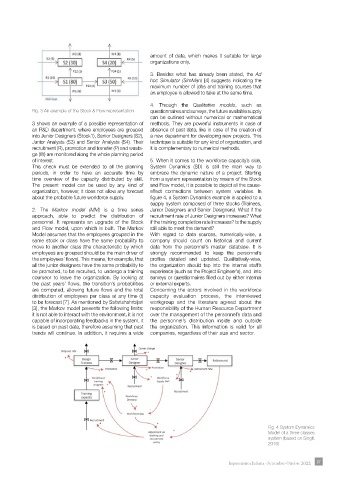
            about the probable future workforce supply.  fi gure 4, a System Dynamics example is applied to a
                                                      supply system composed of three stocks (Trainees,
            2. The  Markov model (MM) is a time series   Junior Designers and Senior Designers). What if the
            approach, able to predict the distribution of   recruitment rate of Junior Designers increases? What
            personnel. It represents an upgrade of the Stock   if the training completion rate increases? Is the supply
            and Flow model, upon which is built. The Markov   still able to meet the demand?
            Model assumes that the employees grouped in the   With regard to data sources, numerically-wise, a
            same stock or class have the same probability to   company should count on historical and current
            move to another class (the characteristic by which   data from the personnel’s master database. It is
            employees are grouped should be the main driver of   strongly recommended to keep the personnel’s
            the employees’ fl ows). This means, for example, that   profi les detailed and updated. Qualitatively-wise,
            all the junior designers have the same probability to   the  organization  should  tap into the  internal staff’s
            be promoted, to be recruited, to undergo a training   experience (such as the Project Engineer’s), and  into
            courseor to  leave  the  organization.  By looking  at   surveys or questionnaires fi lled out by either internal
            the past years’ fl ows, the transition’s probabilities   or external experts.
            are computed, allowing future fl ows and the total   Concerning the actors involved in the workforce
            distribution of employees per class at any time (t)   capacity evaluation process, the interviewed
            to be forecast [7]. As mentioned by Safarishahrbijari   workgroup and the literature agreed about the
            [3], the Markov model presents the following limits:   responsibility of the Human Resource Department
            it is not able to interact with the environment, it is not   over the management of the personnel’s data and
            capable of incorporating feedbacks in the system, it   the  personnel’s  distribution inside  and outside
            is based on past data, therefore assuming that past   the organization. This information is valid for all
            trends will continue. In addition, it requires a wide   companies, regardless of their size and sector.


                                                                                               Fig. 4 System Dynamics
                                                                                               Model of a three classes
                                                                                               system (based on Singh,
                                                                                               2016)


                                                                                 Impiantistica Italiana - Settembre-Ottobre 2022  27

