


Page 30 - Impiantistica Italiana
P. 30
GOVERNANCE


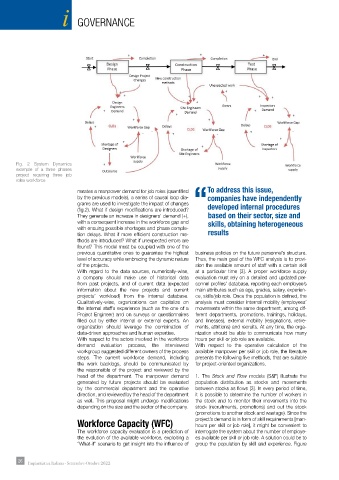
       Fig.  2  System  Dynamics
       example of a three phases
       project  requiring three  job
       roles workforce
                            nerates a manpower demand for job roles (quantified   To address this issue,
                            by the previous models), a series of causal loop dia-  companies have independently
                            grams are used to investigate the impact of changes
                            (fig.2). What if design modifications are introduced?   “developed internal procedures
                            They generate an increase in designers’ demand (+),   based on their sector, size and
                            with a consequent increase in the workforce gap and   skills, obtaining heterogeneous
                            with ensuing possible shortages and phase comple-
                            tion delays. What if more efficient construction me-  results
                            thods are introduced? What if unexpected errors are
                            found? This model must be coupled with one of the
                            previous quantitative ones to guarantee the highest   business policies on the future personnel’s structure.
                            level of accuracy while embracing the dynamic nature   Thus, the main goal of the WFC analysis is to provi-
                            of the projects.                          sion the available amount of staff with a certain skill
                            With regard to the data sources, numerically-wise,   at a particular time [3]. A proper workforce supply
                            a company should make use of historical data   evaluation must rely on a detailed and updated per-
                            from past projects, and of current data (expected   sonnel profiles’ database, reporting each employee’s
                            information about the new projects and current   main attributes such as age, grades, salary, experien-
                            projects’ workload) from the internal database.   ce, skills/job role. Once the population is defined, the
                            Qualitatively-wise, organizations can capitalize on   analysis must consider internal mobility (employees’
                            the internal staff’s experience (such as the one of a   movements within the same department, among dif-
                            Project Engineer) and on surveys or questionnaires   ferent departments, promotions, trainings, holidays,
                            filled out by either internal or external experts. An   and illnesses), external mobility (resignations, retire-
                            organization should leverage the combination of   ments, attritions) and recruits. At any time, the orga-
                            data-driven approaches and human expertise.  nization should be able to communicate how many
                            With respect to the actors involved in the workforce   hours per skill or job role are available.
                            demand evaluation process, the interviewed   With respect to the operative calculation of the
                            workgroup suggested different owners of the process   available manpower per skill or job role, the literature
                            steps.  The  current workforce  demand, including   presents the following five methods, that are suitable
                            the work backlogs, should be communicated by   for project-oriented organizations.
                            the responsible of the project and reviewed by the
                            head of the department. The manpower demand   1. The  Stock and Flow  models (S&F) illustrate the
                            generated  by  future  projects  should  be  evaluated   population distribution  as stocks and movements
                            by the commercial department and the operative   between stocks as flows [3]. In every period of time,
                            direction, and reviewed by the head of the department   it is possible to determine the number of workers in
                            as well. This proposal might undergo modifications   the stock and to monitor their movements into the
                            depending on the size and the sector of the company.  stock (recruitments, promotions) and out the stock
                                                                      (promotions to another stock and wastage). Since the
                            Workforce Capacity (WFC)                  project’s demand is in form of skill requirements [man-
                                                                      hours per skill or job role], it might be convenient to
                            The workforce capacity evaluation is a prediction of   interrogate the system about the number of employe-
                            the evolution of the available workforce, exploiting a   es available per skill or job role. A solution could be to
                            “What-if” scenario to get insight into the influence of   group the population by skill and experience. Figure


       26  Impiantistica Italiana - Settembre-Ottobre 2022

